

The Family of Antonio Maria Lugo
Dedication: This article is dedicated to my old friend from Inglewood, Nicci Lugo (1957-2026)
The Lugo Beginnings
“In 1775 a male baby, destined to exert considerable influence in early California, was born at an established mission, the San Antonio de Padua, near Monterey, the mission being four years old and prospering. The Franciscan father in charge of the mission baptized the baby Antonio Maria Lugo. Antonio’s parents were Francisco Salvador Lugo, a military guard at the mission, and his wife, Juana Vianazul [Martinez]. Under the command of Fernando Rivera, the third governor of Alta California, they had come, with other replacement soldiers and their families and several Franciscan padres, from Alamos, Sonora, where they were recruited.” [Roy Elmer Whitehead, Lugo: A Chronicle of Early California (Redlands, California: San Bernardino County Museum Association, 1978), p. xvi.]
The Lugo Lineage: From Juan Salvador Lugo to Nicci Lugo
My late friend, Nicci Lugo, is the progeny of one of Southern California’s most illustrious families: the Lugo Family. The following graphic illustrates her descent from this famous family. Her earliest Lugo ancestor, Juan Salvador Lugo, was born in Sinaloa and never came to California. The second Lugo in this line, Francisco Salvador Lugo, came from Sinaloa with his wife in 1774, serving as a soldier of the King of Spain. However, it was the third Lugo —Antonio Maria Lugo — who is best known as a soldier, an early resident of the Pueblo of Los Angeles, a Mayor (Alcalde) of Los Angeles, and the owner of the extensive San Antonio Rancho in Los Angeles County. Five generations later came Nicci Lugo who always felt great pride in her vaunted lineage.
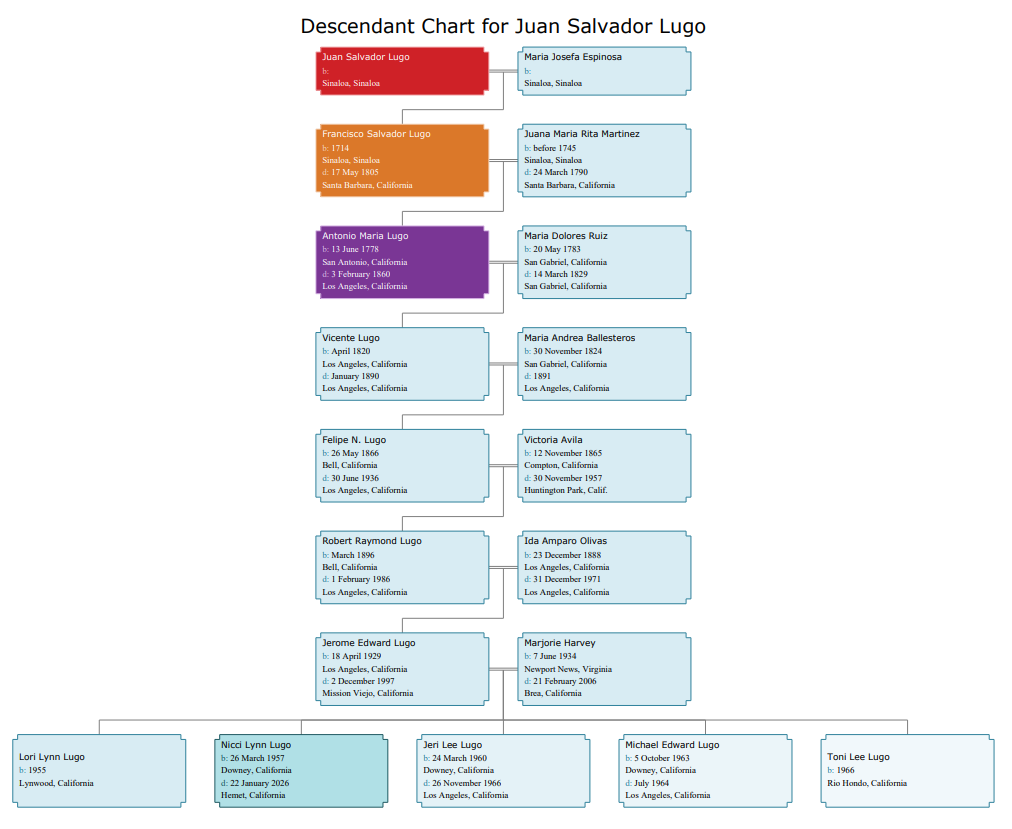
The Lugo Descendancy Chart (Eight Generations from Juan Salvador Lugo to Nicci Lugo and Her Siblings.
The Lugo Family as Early Settlers
In the early settlement of Los Angeles, few families epitomize the “Californio spirit” better than the Lugo family. The Lugo family, in fact, had a first-row seat in the founding of Los Angeles. Francisco Lugo was one of the soldiers who escorted and guarded the Mexican pobladores who settled El Pueblo de Los Angeles in September 1781. His name is found on the plaque that pays tribute to those who were present at the official beginnings of Los Angeles on September 4, 1781.
The Baptism of Antonio Maria Lugo
In fact, Dr. Whitehead was wrong about the date of birth for Antonio Maria Lugo. The actual baptism of Antonio Maria Lugo took place on June 13, 1778, not 1775. A translation of the baptism states:
On the 13th of June of 1778, I baptized privately a little boy a little boy born at eleven o'clock at night of said day, in danger of death; legitimate son of Francisco Salvador de Lugo and of Juana Maria Villanazur and on the 21st of the said month and year I applied the Holy Oils to him, and I named him ANTONIO MARIA [LUGO]. His godfather was Soldier Antonio Cota, Corporal of the escort, and to attest to this, I signed it.
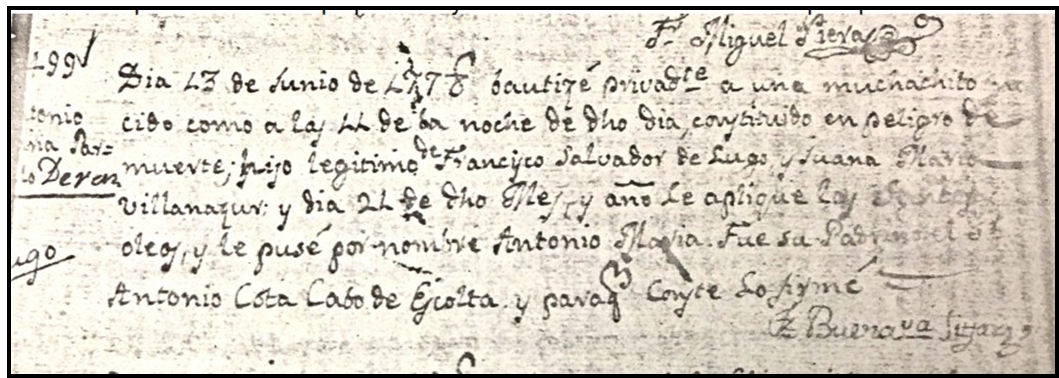
The Baptism of Antonio Maria Lugo (13 June 1778), San Antonio de Padua Baptism #499, at FamilySearch.org, FHL Microfilm 913297, Image 115 of 657.
The Background of Jose Francisco Salvador Lugo
José Francisco Salvador Lugo was born at Villa de Sinaloa (now Sinaloa de Leyva in the current state of Sinaloa), the son of Juan Salvador Lugo and his wife, María Josefa Francisca Espinosa. José Francisco enlisted as a soldado de cuera (“leather jacket soldier”) about 1757 at Villa de Sinaloa, where he married Juana María Rita Martínez y Villanasul around 1760. Soon after, he was transferred to Loreto Presidio, Baja California, which was over 190 miles away from Villa de Sinaloa across the Gulf of California.
Francisco Salvador Lugo was recruited by Capitán Fernando Rivera y Moncada for the 1774 Expedition to Alta California. Francisco, his wife, and three young children made the long trek up the peninsula to Alta California in 1774. They remained in Alta California for the rest of their lives. Francisco and his wife, Juana Maria Rita Martinez y Vianazul, eventually had nine children, four of whom were born in Sinaloa and five in California (one died at a very young age).
Francisco was first stationed in Monterey and later in San Luis Obispo. Rivera’s Expedition of 1781 arrived in San Gabriel, California from Alamos, Sonora after a lengthy journey. On October 30, 1781, with the soldiers settled at San Gabriel [and preparing for their next move to Santa Barbara], Lieutenant Josef Francisco Ortega assembled a roster of his soldiers, which included two officers, three sergeants, two corporals and 54 soldiers [Provincial State Papers, Benicia Military, Tomo III, pp. 60-61). Francisco Salvador de Lugo was among the many soldiers listed,having transferred from the south specifically for this event.
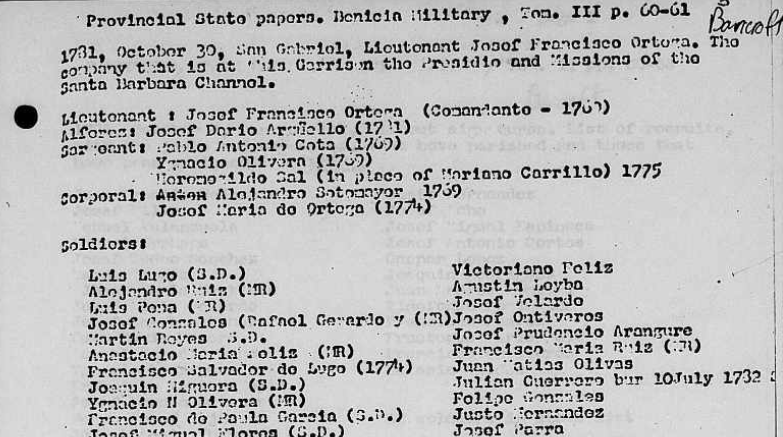
October 30, 1781 Roster of San Gabriel Soldiers by Josef Francisco Ortega, Provincial State Papers, Benicia Military, Tomo IIII, pp. 60-61 at FamilySearch.org, FHL Microfilm 1548299, Item 6, Image 938 of 1,025.
The Lugo Affiliation with Los Angeles Begins
When Los Angeles was founded in September 1781 and Santa Barbara was established in April 1782, Lugo was among the soldiers who served at the new Presidio of Santa Barbara, which was responsible for the security of the young pueblo of Los Angeles. Francisco Lugo was listed as a soldier at the Santa Barbara Presidio on July 1, 1782. His family lived with him at the Presidio.
Over the next few years, Francisco Lugo and several other soldiers from the Santa Barbara Presidio would be listed as members of the escolta [escort or guard] to guard over the young pueblo of Los Angeles. On July 1, 1784, Lieutenant Phelipe de Goycoechea created a roster of his 60 soldiers serving at the Santa Barbara Presidio:
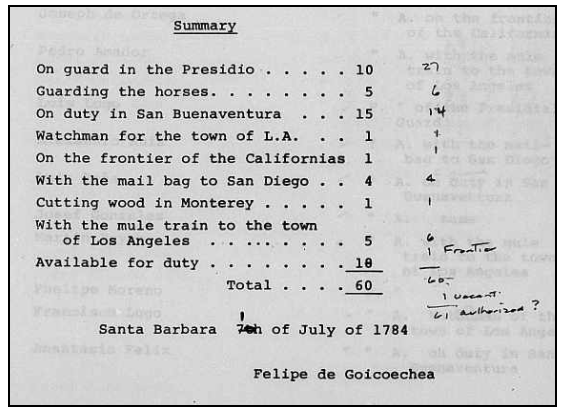
July 1, 1784 Disbursement of the Santa Barbara Presidio at FamilySearch.org, FHL Microfilm 1548299, Item 6, Images 948-950 of 1,025.
In the “Goycoechea Disbursement,” the duties of the sixty presidio soldiers were shown for each soldier. Francisco Lugo was listed as “Watchman of the town of Los Angeles.” This was the beginning of the long association of the Lugo family with the Pueblo of Los Angeles. By 1816, Francisco’s son would be Alcalde (Mayor) of the town.
Francisco Lugo in the 1787 Census
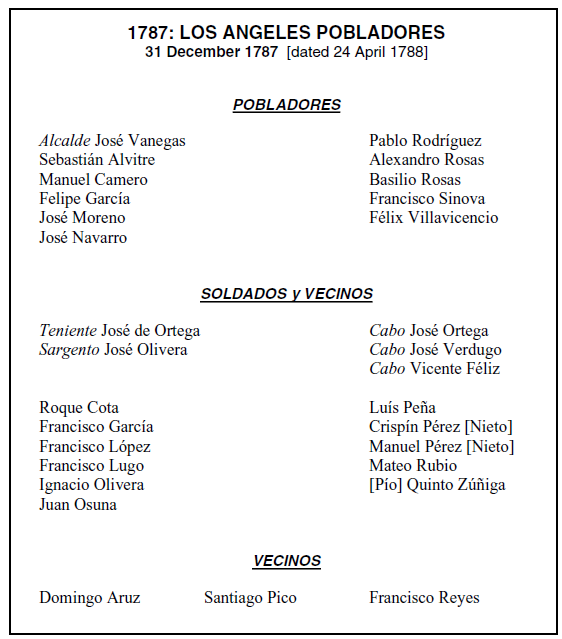
In 1787, a census list of people living in Los Angeles listed Francisco Lugo as one of several soldiers among the small population in Los Angeles [1787 List of Los Angeles Pobladores (31 Dec. 1787 – dated 24 April 1788) in William M. Mason, Los Angeles Under the Spanish Flag, p. 69].
The 1790 Census at Santa Barbara Presidio
Francisco Lugo was discharged on 28 October 1788, but appeared in a 1789 census list, so evidently he had gone back to Santa Barbara to serve a few more years. By the time that the 1790 census was taken in Santa Barbara, Francisco was a widower and working as a laborer. Described as “Español,” and a 50-year-old native of Sinaloa, Jose Francisco Lugo was the father of six children, ranging in age from 17 to 7. His 16-year-old son, Antonio Maria, the future Mayor of Los Angeles, would enlist in the Spanish Army two years later.
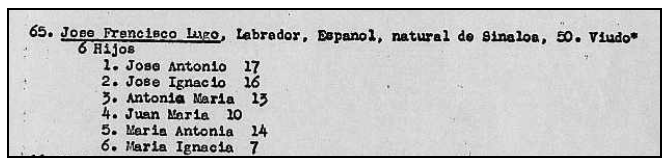
Jose Francisco Lugo Family in the 1790 Santa Barbara Census at FamilySearch.org, FHL Microfilm 1548299, Item 6, Images 971 of 1,025.
Just before the census was taken, Juana Vallanasul, the wife of Francisco Lugo, had died on March 21, 1790, as noted in the following burial record [Santa Barbara Presidio Burial #18 (24 March 1790)], which is also translated below:
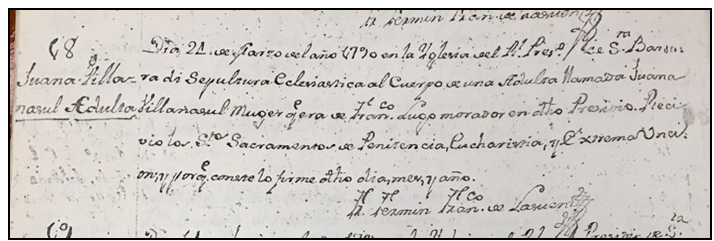
Translation: On the 24th of March of 1790 in the Church of the Presidio of Santa Barbara, the ecclesiastic burial of the body of an adult called Juana Villanasul, wife of Francisco Lugo inhabitant of the said Presidio. Previously she had received the holy sacraments of penance, eucharist and extreme unction…
According to William M. Mason’s Los Angeles Under The Spanish Flag [Page 18], a list made in 1792 by Felipe Goycoechea, Commander at Santa Barbara, the garrison of Los Angeles consisted of six soldiers: Sergeant Jose Ignacio Olivera, Corporal Jose Maria Verdugo, and several privates: Francisco Lugo, Vicente Feliz, Roque Cota, and Antonio Cota.
According to Dr. Whitehead, in Lugo: A Chronicle of Early California [Page 102], “In 1794, Antonio Maria Lugo was nineteen years old and a soldier of Spain, having enlisted, as most of the young men did, as soon as he was old enough. He was full grown now, over six feet tall, strong, sinewy, and an expert horseman. He must have made an impressive sight in his leather jacket uniform.” By this time, the younger brother of Antonio, 18-year-old Juan Lugo, had also enlisted in the Spanish army and was assigned to the Presidio of Santa Barbara. Thus, all of Francisco’s surviving sons had now become soldiers. Their 14-year-old sister, Maria Antonia, had married Sergeant Ignacio Vallejo, leaving the father Francisco with one child at home, 11-year-old Maria Ignacia.
As Dr. Whitehead writes in Lugo: A Chronicle of Early California [Page 104], “In 1796, Antonio Maria Lugo was twenty-one years of age and had been a soldier of Spain for about three years. His father, Francisco, and his two older brothers and one younger brother were also soldiers of Spain, all assigned to the military garrisons at the missions or presidios in California.”
Maria de los Dolores Dominga Ruiz
On January 17, 1796, Antonio Maria Lugo was married at Mission Santa Barbara to Maria de los Dolores Dominga Ruiz, the daughter of Efigenio Ruiz and Maria Rosa Lopez (Monreal). The Ruiz family had come to California in the Expedition of 1781 that arrived at San Gabriel and later founded Los Angeles, San Buenaventura, and Santa Barbara. Maria Dolores had been baptized on May 28, 1783 at Mission San Gabriel two years after the arrival of her parents in California. Efigenio Ruiz was from El Fuerte, Sinaloa, while his wife was from Alamos, Sonora. Her baptism was #11 at the Santa Barbara Presidio as is reproduced below and translated farther below.
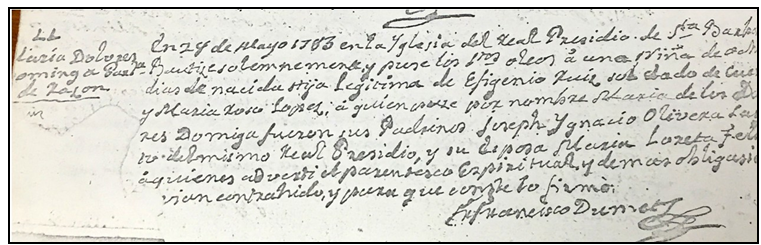
Translation: On the 24th of May of 1783 in the Church of the Real Presidio of Santa Barbara, I baptized solemnly and poured holy oil on a little girl eight days from birth, the legitimate daughter of Efigenio Ruiz, leather jacket soldier, and Maria Rosa Lopes, whom I gave the name Maria de los Dolores Dominga. Her godparents were Joseph Ygnacio Olivera Feliz of the same presidio and his spouse, Maria Loreta Felis, whom I advised of their spiritual parentage and more obligations….
The Descent from Efigenio Ruiz to Nicci Lugo
Efigenio Ruiz brought his family from El Fuerte, Sinaloa, up to Los Angeles in the Expedition of 1781. He came to California at the age of 36 with his 28-year-old wife, Maria Rosa Lopez, and three children between the ages of 10 years and one year. Efigenio was discharged from the military on October 19, 1789 and, like many of his fellow soldiers, he initially retired to the Pueblo of Los Angeles where he was living at the time of the 1790 census with his wife and four children. He was classified as “Español.” He died at the Santa Barbara Presidio on June 13, 1795 (Santa Barbara Presidio Burial #37). The following chart shows the lineage from the soldier Efigenio Ruiz to Nicci Lugo, six generations later.
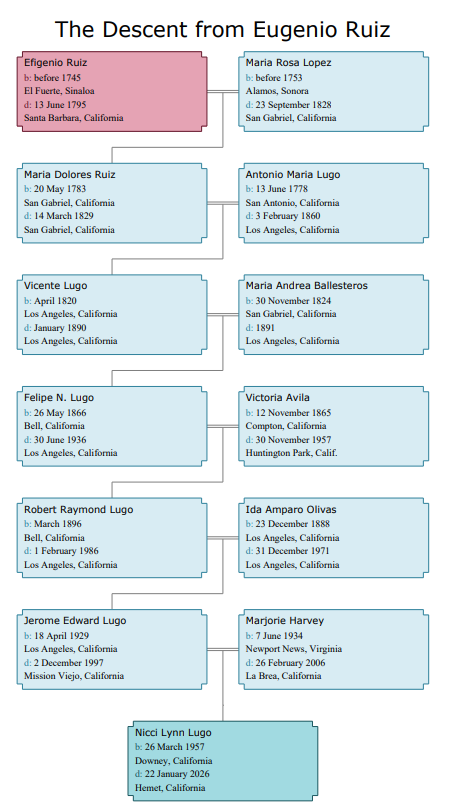
The Descent from Efigenio Ruiz to Nicci Lugo (Seven Generations)
The Marriage of Antonio Maria Lugo and Maria Dolores Ruis (1796)
The marriage of Antonio Maria Lugo and Maria Dolores Ruis was only the twentieth marriage performed at the Santa Barbara Presidio for members of the soldier caste. The marriage record as performed at the Santa Barbara Presidio Chapel has been reproduced below and is also translated below:
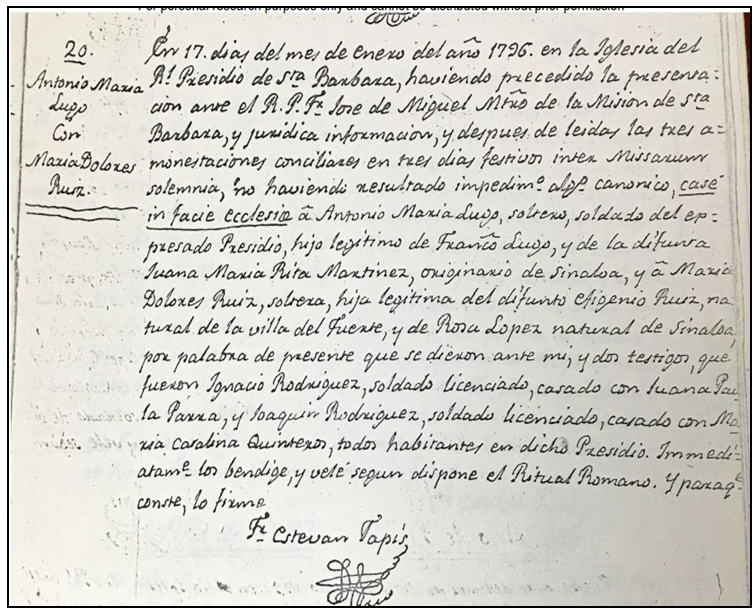
Santa Barbara Presidio Marriage #20 (17 January 1796) between Antonio Maria Lugo and Maria Dolores Ruis.
Translation:
In the Margin: 20. Antonio Maria Lugo with Maria Dolores Ruiz.
Text: On the 17th day of January of the year 1796, in the Church of the Presidio of Santa Barbara, having published the presentation before Father Jose de Miguel, Minister of Santa Barbara, and judicial information, and since reading the three conciliar banns on three festive days in solemn mass, and no impediments [to marriage] having resulted, I married in the face of the church, ANTONIO MARIA LUGO, single, soldier of the expressed presidio, legitimate son of FRANCISCO LUGO, and of the deceased JUANA MARIA RITA MARTINEZ, originally from Sinaloa, and [married to] MARIA DOLORES RUIZ, single, legitimate daughter of the deceased EFIGENIO RUIZ, native of the Village of Fuerte, and of ROSA LOPEZ, native of Sinaloa, by the words of those present that came before me, and two witnesses, who were Ignacio Rodriguez, a licensed soldier, married to Juana Paula Parra, and Joaquin Rodriguez, a licensed soldier married to Maria Carolina Quinteros, all inhabitants of the said Presidio. Immediately I bless you, and I watched according to the Roman Ritual, and for the record, I signed it.
Antonio Maria Lugo in 1799
According to Dr. Whitehead, in Lugo: A Chronicle of Early California [Page 106], “In 1799, Antonio Maria Lugo was twenty-four years of age, married, and a soldier with six years of [military] service, stationed at the Santa Barbara presidio. His chief work, beside guarding the Spanish properties, was policing the native Indians when they violated the laws of the land by stealing livestock and other property which could be carried away. The soldiers, as policemen, sometimes had to chase the thieves for miles to catch them, if they ever did.”
The Lugo Family in 1800
At the dawn of the Nineteenth Century, the King of Spain was Charles (Carlos) IV, and Jose Joaquin Arrillaga was the newly appointed Governor of California [for the second time]. During the preceding thirty-one years, the Spaniards in California had built 18 new Spanish missions and four presidios. In the Pueblo of Los Angeles, there were now seventy families, with 315 people living around the central plaza. By this time, Francisco Salvador Lugo was retired but four of his sons were serving at the missions and presidios of California. Only one son of Francisco – Salvador – had not enlisted in the army as he had been killed as a child when he was a boy by falling off a horse. At this point in his life, Antonio Maria Lugo – one of those sons – was 25 years of age and had served in the army for seven years.
Nicci Lugo’s Ancestors in the 1804 Easter Census
According to William M. Mason’s Los Angeles Under The Spanish Flag [Pages 77-79], on April 15, 1804, the parish priest at San Gabriel Mission compiled a list of the persons living in the Los Angeles Pueblo who were obliged to fulfill their duties towards the Catholic Church. This list included the following ancestors of Nicci Lugo from all branches of her lineage:
1. Anastacio Avila and his brothers, José María, Ylaria Avila. Their father, Cornelio Avila from El Fuerte (Sinaloa), had died on 23 November 1800 in Santa Barbara.
2. Juan de Dios Ballesteros and his wife María Teresa Sepúlveda. He was from Mexico City while she was from Villa de Sinaloa.
3. The widow María Candelaria Redondo, the wife of the deceased Francisco Xavier Sepúlveda who had died in 1788. They were both from Sinaloa.
4. Fructuoso María Ruiz and his wife María Dolores Lugo. Fructuoso had been born in El Fuerte, Sinaloa. His wife was a native of Santa Barbara.
5. Rosa María Lopez, widow of Efigenio Ruiz, who had died on 13 June 1795 in Santa Barbara. Although her husband was from El Fuerte (Sinaloa), she was believed to have come from Alamos, Sonora.
6. Manuel Figueroa and his wife Gertrudis Silvas. He came from Cosala, Sinaloa, while his wife was believed to have been from Villa de Sinaloa.
7. María Pascuala Lugo, the widow of José Miguel Silvas.
8. Manuel Ygnacio Lugo and his wife Gertrudis Limón y Sánchez.
9. Francisco Lugo, widower of Juana María Martínez Vianazul who had died in 1790.
Nicci grew up in the Greater Los Angeles area and was one of the few people who could boast that she had at least thirteen ancestors living in the small pueblo of Los Angeles in 1804. During the year after the Easter Census, on May 17, 1805, the father of the Lugo brothers, Francisco Salvador Lugo, died and was buried in the Santa Barbara Presidio cemetery. With this death, the progenitor for many of the California Lugo’s passed the mantle of the Spanish military to his sons. Although most of the Lugo’s in California were believed to be related and from Villa de Sinaloa [or born later in Alta California], the relationship with some of the Lugo’s has not yet been confirmed.
Antonio Maria Lugo is Discharged (1810)
According to Roy Whitehead [Page 119], in 1810, Antonio Maria Lugo was a corporal in the Spanish army stationed with his family at the Santa Barbara Presidio. He was thirty-five years of age and had been 17 years in the military service. He had also been married since 1796 and had four living children: two sons and two daughters. Antonio Maria Lugo was discharged from the military in 1810 after serving for 17 years. He took up residence with his wife and children in Los Angeles, where he cultivated pueblo lands and had his own garden.
The Rancho San Antonio Grant (1814)
In 1814, Antonio Maria Lugo received a royal grant from Governor Luis Antonio Agüello for his military service. This grant from the King of Spain – known as Rancho San Antonio – consisted of a large amount of land between the Los Angeles and Rio Hondo rivers. As early as 1795, Francisco Salvador Lugo and Antonio María Lugo had begun construction on what is now known as Casa de Rancho San Antonio or the Henry Gage Mansion. The house was located about 10 miles southeast of the Pueblo of Los Angeles and is today located at 7000 East Gage Avenue in Bell Gardens. It helped to qualify the younger Lugo for the land grant of 1814.
The Lugo ranch eventually grew to encompass 29,514 acres, including what are now the cities of Bell Gardens, Commerce, and parts of Bell, Cudahy, Lynwood, Montebello, South Gate, Vernon and East Los Angeles. It is believed that Don Antonio pastured 30,000 cattle and 1,500 horses on his property. There were tales that said Doñ Antonio could ride his horse for an entire day and not leave the bounds of his property. The following map by the Workers Progress Administration (1937), shows the Mexican and Spanish land grants from 1784 to 1822, including Rancho San Antonio which was located to the southeast of the Pueblo of Los Angeles.
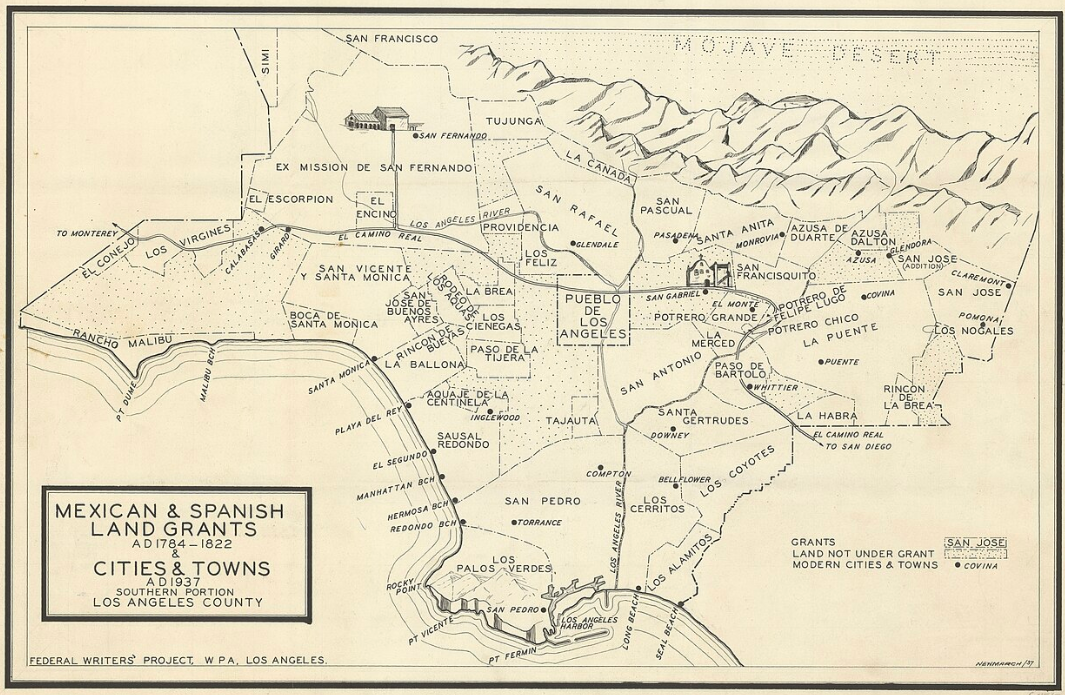
Wikipedia, Mexican and Spanish Land Grants (A.D. 1764-1822) Cities and Towns by the Federal Writers’ Project (Works Progress Administration, 1937).
The 1816 Census of El Pueblo of Los Angeles
William M. Mason, Los Angeles Under the Spanish Flag [pp. 83-87], showed a list of settlers, retired soldiers and citizens of the Los Angeles Pueblo in 1816, noting the year of their arrival in the pueblo and other information. Nicci Lugo, born in 1957 as the great-great-great-granddaughter of Antonio Maria Lugo, had several ancestral inhabitants of Los Angeles in this census. They were as follows:
1. Antonio María Lugo, Alcalde, [married to María Dolores Ruiz], arrived in l809. He was given a sitio by Don José Arguello. He cultivated pueblo lands and had a garden.
2. Juan de Dios Ballesteros, [married to Teresa Sepúlveda], arrived in 1796. He was not given land, but he did sow plantings in the pueblo lands. He also had two gardens. Juan de Dios Ballesteros was originally from Mexico City and the great-great-great-great-grandfather of Nicci Lugo through her great-grandmother, Victoria Avila.
3. Anastacio Avila, [married to Juana Ballesteros], arrived in 1799. He had land which he cultivated, and he lived at the rancho of Manuel Gutiérrez with the permission of Captain Don José Arguello. Anastacio Avila was the great-great-great-grandfather of Nicci Lugo through her Avila ancestors too.
4. Desiderio Hibarra [Ybarra], [married to María de Jesús Valeriana Lorenzana], arrived in 1814. He had no land of his own but did have a garden. He was a great-great-great-great-grandfather of Nicci Lugo, also through her Avila ancestors.
5. Frutoso [Frctuoso] Ruis, [married to María Dolores Lugo], arrived in 1799. He was given land and cultivated it. Frutoso [Fructuoso] Maria Ruiz was also a great-great-great-great-grandfather of Nicci Lugo.
6. Ygnacio Lugo, retired soldier, [married to Gertrudis Limón], had arrived in about 1800 but as not given any land. He was a great-great-great-great-great-grandfather of Nicci Lugo, also through her Avila ancestors.
In addition, two of Nicci Lugo’s ancestors were distinguished enough to serve as Alcalde (Mayor) of Los Angeles: Antonio Maria Lugo (1816-1819) and Anastacio Avila (1819-1821).
Antonio Maria Lugo as Mayor (1816-1819)
Lugo maintained a home in the pueblo de Los Angeles, near the plaza and across from the church (that was formally dedicated in 1822). He was Alcalde (Mayor) of Los Angeles from 1816 to 1819, and a leader in most of the social functions of that time. He invited travelers to visit his beautiful ranch house at Rancho San Antonio.
The Family of Antonio Maria Lugo and Dolores Ruiz (1797-1823)
From 1797 to 1823, Antonio Maria Lugo and Dolores Ruiz had thirteen children. The first two died in their infancy and the third child died at the age of 14. Nine of the children lived to be adults and started their own families. Vicente Lugo was the second-to-last-child, born on April 5, 1922 at the Lugo adobe home on San Pedro and Second Streets in Los Angeles. His baptism has not been found but he was confirmed on November 9, 1831 at the Los Angeles Plaza Church. Vicente was born soon after California and Mexico had gained independence from Spain.
Mexico Becomes an Independent Nation (1822)
According to Roy Whitehead [Pages 131-132], the first Congress of the new nation of Mexico convened on February 24, 1822 in Mexico City, but news of that meeting did not reach Los Angeles until March. California was now a province of Mexico and all ties to Spain had been severed. On November 9, 1822, Luis Antonio Argüello arrived in Monterey, California, bearing official notification from the new Mexican Government that he was the Governor of California. Governor Argüello was a 36-year-old native son of California and was now in charge of a state that had about 3,500 Spanish-Mexican people and about 100,000 Indigenous people. Antonio Maria Lugo had known Argüello for many years.
Antonio Maria Lugo in 1825 and 1827
According to Roy Whitehead [Page 139], by 1825, Doñ Antonio Maria Lugo was fifty years old [he was actually 46 years old] and was living at his hacienda at San Pedro and Second Streets in Los Angeles. He had been married for almost thirty years and had twelve children. In April and May of 1825, major flooding of all the rivers had taken place thanks to heavy rains.
By 1827, Antonio Maria Lugo’s livestock had increased in number at his San Antonio Rancho. Because his rancho was close to the port of San Pedro, he was able to sell his hides and tallow there. It was around this time that Antonio Maria Lugo sought and received concessions for more land consisting of land that is now in the present-day towns of Lynwood, Bell, and Monticello [and extending as far south as the present-day City of Compton]. But the grants from Governor Echeandia were temporary concessions and not considered of a permanent nature.
The Death of Maria Dolores Ruiz de Lugo (1829)
On March 13, 1829, Maria Dolores Ruiz de Lugo, the wife of Antonio Maria Lugo since 1796, died at the age of forty-six at their hacienda in Los Angeles. She was buried in the San Gabriel Mission Cemetery. Thirteen children had been born to Antonio Maria and Dolores, ten of them during the Spanish period and three of them during the Mexican period (Vicente, Maria de Jesus, and Jose Antonio). Five of the children were still living at home when Dolores died: Maria Rita Merced (14 years old), Mariano (11), Vicente (7), Maria de Jesus (6), and Jose Antonio III (4).
Political Events in the Early 1830s
Dr. Whitehead, in Lugo: A Chronicle of Early California [Pages 145-212], discusses the various political maneuvers taking place in the State of California during the period from 1830-1840. In the middle of this decade, on May 23, 1835, the Mexican Congress officially elevated the Pueblo (town) of Los Angeles to the status of a Ciudad (City), also declaring it the capital of Alta California.
The Lugo Family in the Census of 1836
As noted in Dr. Whitehead’s book [Page 188], the first census of the Mexican period was taken in Los Angeles in 1836. The population of Los Angeles had grown to 2,228, of which 553 were domesticated Indians working as laborers and servants. Another 46 people were foreigners and 21 were Americans, but 1,608 inhabitants of Los Angeles were considered Californians. Antonio Maria Lugo, who was probably the wealthiest Californian at the time, was listed in the census, along with his sons Vicente (14), Jose Antonio (9) and Maria de Jesus (12). The portion of the page showing Antonio Maria’s family is shown below.
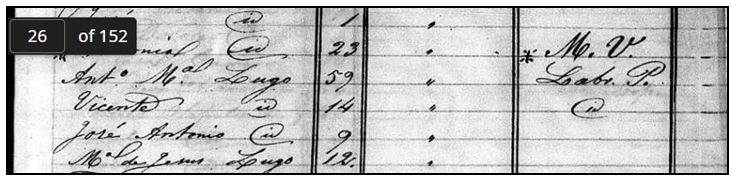
Padrones de la Ciudad de Los Angeles, 1836, 1844 at FamilySearch.org, FHL Microfilm 913156, Images 26 and 27 of 152.
The Third Lugo Generation in California: Vicente Lugo (1822-1890)
Vicente Lugo was born April 5, 1822 in Los Angeles as the son of Antonio Maria lugo and Maria Dolores Ruiz. Some sources claim he was born in 1820, but his baptism has never been found in the San Gabriel Mission Archives. He was married on December 11, 1841 at San Gabriel Mission to Andrea Ballesteros. Andrea was the daughter of Juan Antonio Ballesteros [a native of Santa Barbara] and of Maria Faustina Figueroa [also a native of Santa Barbara]. Her baptism is shown below and translated into English:
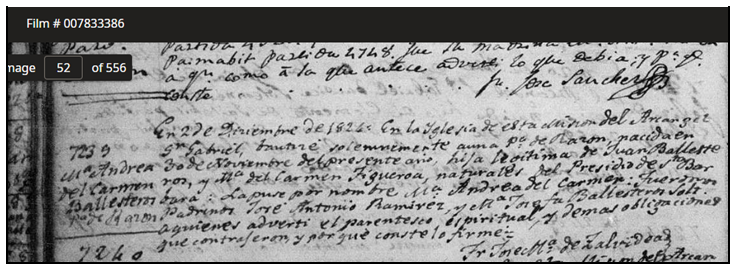
San Gabriel Mission Baptism #7239 (2 December 1824).
Translation:
In the Margin: 7239. Maria Andrea del Carmen Ballesteros. Person of Reason.
Text: On the 2nd of December of 1824 in the church of this Mission of the Arcangel San Gabriel, I baptized solemnly a baby girl of reason [Christian parents], born on the 30th of November of the present year, legitimate daughter of Juan Ballesteros and Maria del Carmen Figueroa, natives of the Presidio of Santa Barbara, and gave her the name Maria Andrea del Carmen. The godparents were Jose Antonio Ramirez and Maria Josefa Ballesteros, single, whom I advised of the spiritual parentage and more obligations…
The Ballesteros Ancestors
The paternal grandfather of Maria Andreas Ballesteros was Juan de Dios Ballesteros who was born in Mexico City around 1760. His wife, Maria Teresa Sepulveda, was from Villa de Sinaloa. Her maternal grandfather, Manuel Antonio Figueroa, was believed to have come from Cosala, Sinaloa. His wife, Anna Gertrudes Silva, came from Villa de Sinaloa. Like the Lugo family, most of the men in the Ballesteros family were soldiers serving the King of Spain. Nicci Lugo actually had two lines of descent from Juan De Dios Ballesteros: One through his son Juan Antonio Ballesteros and another through his daughter Maria Juana Ballesteros. The two lines merged with the marriage of Felipe Lugo and Victoria Avila in 1888.
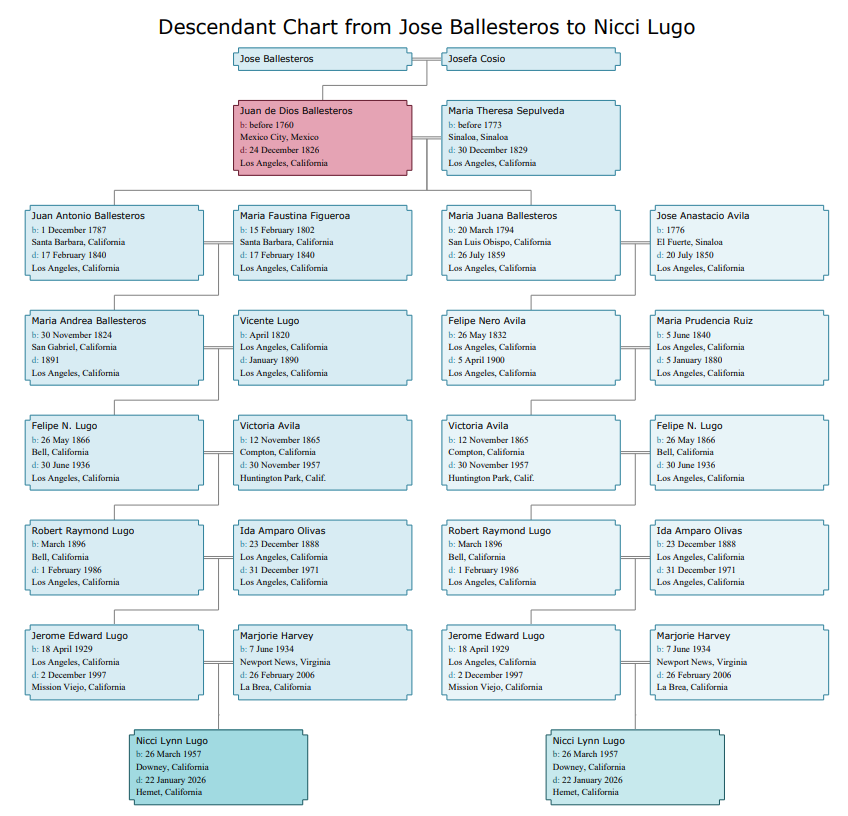
The Two Ballesteros Lines of Descent to Nicci Lugo.
Between 1842 and 1865, Vicente Lugo and Maria Andrea Ballesteros would have nine children. Three of the children died in infancy. However, Vicente Lugo also had three illegitimate children by two women between 1839 and 1851.
Antonio Maria Lugo And the Chino Land Grant (1841)
In March 1841, Antonio Maria Lugo petitioned the government for the Rancho Santa Ana del Chino, a 22,193-acre Mexican land grant in the Chino Hills and southwestern Pomona Valley in present-day San Bernardino County. According to Whitehead [Page 223], Lugo “immediately began to develop the property. He built a good adobe house for himself there and moved 3,800 head of cattle, 400 horses and a large flock of sheep from his San Antonio Rancho near Los Angeles, to Chino, which was about thirty miles away.” Later in the year, the permanent grant was issued by Governor Albarado to Antonio Maria Lugo and his son-in-law, Isaac Williams [the spouse of Maria de Jesus Lugo, to whom he was married in 1837]. Now that they had been granted permanent ownership, the three brothers — Jose Maria, Jose del Carmen, and Vicente — prepared to build permanent residences on the San Bernardino Rancho and move their families into them. Soon, the sons would send their cattle to the new ranch as well. Roy Whitehead describes the Lugo family in 1842 [page 235]:
“The three Lugo brothers helped each other and covered the entire San Bernardino Valley in their work. It was not long before each one of them had additional help living near them, besides their families. The cattle on their rancho had now increased to 6,000 head, and they had many horses and mules. They also had a halfway station between their new homes and their father’s house in Los Angeles, which was their brother-in-law’s Rancho Chino, situated thirty miles from Los Angeles and thirty miles from the San Bernardino Rancho. Rancho Chino was rapidly becoming a stopping place for many visitors from the East to Los Angeles.”
The great problem Don Antonio Maria faced was the protection of his new property in the San Bernardino area. Hostile Indians (usually Paiute or Cahuilla) and outlaws frequently attacked the ranchos and took off with stock. Defending his stock against such raids became the primary concern of any landowner during the Mexican period in California. For Doñ Antonio Maria, the continual raids on his cattle in the frontier area of the San Bernardino and Yucaipa Valleys was the worst headache. Many of the culprits were Paiute Indians from the Mojave Desert. Expert horsemen, the Paiute would sweep down the Cajon Pass at night to do their work.
The 1844 Los Angeles Census
In 1844, another census was taken of the Los Angeles area, but this census included the San Bernardino and Yucaipa Valleys. Roy Whitehead [Pages 243-244] discussed the number of Lugos found across the entire Southland, extending through several ranchos. The copies of the original census are very dark but, Marie E. Northrop, in her article “The Los Angeles Padron of 1844,” The Historical Society of Southern California Quarterly, December, 1960, Vol. 42, No. 4 (December, 1960), p. 411, showed the following page in a table setting.
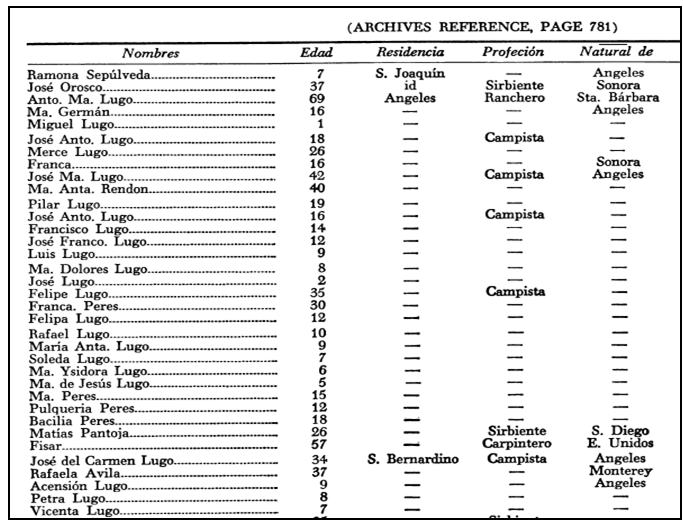
Marie E. Northrup, “The 1844 Los Angeles Census,” The Historical Society of Southern California Quarterly, December, 1960, Vol. 42, No. 4 (December, 1960), p. 411.
On Page 781 of the Archives, we see Antonio Maria Lugo, a 69-year-old native of Santa Barbara, near the top of the page. On March 8, 1842, Antonio Maria had taken Maria Florentina de Jesus German, a 16-year-old girl, as his second wife. She was listed right under his name. Also listed were members of Antonio Maria’s extended family, including his 18-year-old son, Jose Antonio Lugo (born in 1825); his 42-year-old son, Jose Maria Lugo (born in 1802), and his 26-year-old daughter, Merce [Merced] who was born in 1818.
Farther down on the page, we also see 35-year-old Felipe Lugo (born in 1807) who was married to Francesca Perez. It is believed that they had fifteen children born between 1832 and 1856. Another son was 34-year-old Jose del Carmen Lugo and his wife Rafaela Avila [Castro], plus their three children. On the very next page (Page 782), we find the family of 23-year-old Vicente Lugo and 18-year-old Andrea Ballesteros. At this time, they had a seven-month-old son named Antonio Maria Lugo, named after his grandfather.
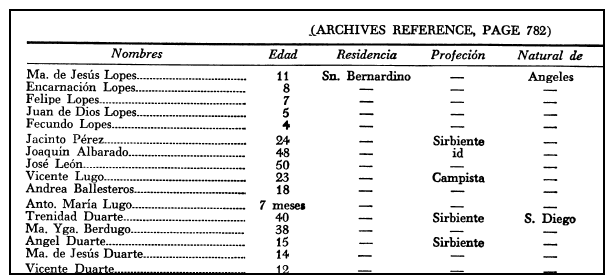
Marie E. Northrop, “The Los Angeles Padron of 1844,” The Historical Society of Southern California Quarterly, December, 1960, Vol. 42, No. 4 (December, 1960), p. 412.
War Comes to California (1845-1848)
Tensions between the United States and Mexico had been growing, highlighted by various incidents taking place in both California and Texas. In the fall of 1845, President Polk sent his representative John Slidell to Mexico. Slidell was supposed to offer Mexico $25,000,000 to accept the Rio Grande boundary with Texas and to sell New Mexico, Arizona, and California to the U.S. However, the President of Mexico, preoccupied with internal dissension and suspicious of American intentions, refused to see Slidell. Slidell returned home, telling Polk that Mexico needed to be “chastised.”
In the meantime, President Polk had ordered Major General Zachary Taylor, with 3,000 men under his command, to advance from the Nueces River to the Rio Grande in Texas. He reached the river in April 1846. A Mexican force crossed the river to meet him. On April 25, the small body of American cavalry was defeated by the superior Mexican force. This incident gave President Polk the pretext he needed. Claiming that Mexico had “invaded our territory and shed American blood on American soil,” he asked Congress to declare war. They did so on May 13, 1846.
Accounts of the War
Accounts of the Mexican-American War in California have been provided by Neil Harlow in his book California Conquered (published in 1982) and by Lisbeth Haas in her article, “War in California, 1846-1848” (which was published in Ramón A. Gutiérrez and Richard J. Orsi’s Contested Eden). Roy E. Whitehead, in Lugo: A Chronicle of Early California, discusses the war and politics that took place during this period on page 274 through 321. These sources should be consulted for a detailed account of the events that took place in California between 1846 and 1848.
Major John C. Fremont Takes Control (1846-1847)
In 1846, Major John C. Fremont played a pivotal (and controversial) role in the U.S. conquest of California, acting as a catalyst for the Bear Flag Revolt in June and commanding a battalion against Mexican forces. In July, he led the insurrection among American Californians against the Mexican commander, Jose Castro. Even though Fremont acted independently, his actions were assimilated into the broader U.S. Navy take-over under Commodore John D. Sloat in July 1846. Many historians consider Fremont’s activities to be both heroic and reckless, but they also realize that he did help to expedite the transition of California to American control. Frémont and about 160 of his troops, sailing from San Diego, took Los Angeles on August 13. Later in the year, under orders from Commodore Robert F. Stockton, Fremont led a military expedition of 300 men to capture Santa Barbara.
The Treaty of Cahuenga (1847)
On January 13, 1847, Fremont accepted Andres Pico’s surrender at the Treaty of Cahuenga, which ended the war in California. The articles of capitulation provided every citizen with the same rights as United States citizens. Californios were all guaranteed the protection of their life and property and the right to unhindered movement and travel, and the men had to pledge that they would not take up arms again for the duration of the war with Mexico.
The Treaty of Guadalupe Hidalgo (1848)
When the Treaty of Guadalupe Hidalgo was signed on February 2, 1848, Mexico handed over to the United States 525,000 square miles of land. The present states of California, Arizona, Nevada, New Mexico, Nevada, and Colorado were ceded by this treaty. In compensation, the U.S. paid $15,000,000 for the land and met other financial obligations to Mexico. Of the treaty’s twenty-three articles, four defined the rights of Mexican citizens and Indian people in the territories. Californians were given the freedom to live in ceded territories as either American or Mexican citizens and their property was to be “inviolably respected.” Those Californians who chose to become Americans would be entitled to “the enjoyment of all the rights of citizens of the United States according to the principles of the constitutions.” The 1848 treaty also provided that the Mexican land grants would be honored. As required by the Land Act of 1851, a claim was filed with the Public Land Commission in 1852, and the grant was patented to Antonio Lugo in 1866 (six years after his death).
The Lugo Family in the 1850 United States Census
On September 9, 1850, California would be admitted to the Union as its thirty-first state. The state was initially divided into 27 counties. [Today, California has 58 counties.] The first U.S. federal census recorded in Los Angeles a city of population of 1,610 and a county population of 3,530. The foreign-born population now totaled 699.
On February 4, 1850, the family of the 76-year-old grazier [a person who fattens cattle or sheep for market], Antonio Maria Lugo, living at Dwelling 313, was recorded. According to the census, Antonio Maria Lugo stated that he owned $20,000 of property and was a native of California. Living with him was his young 24-year-old wife, Maria, and their three small children: Manuel (8 years old), Benabea (5), and Sarah (3).
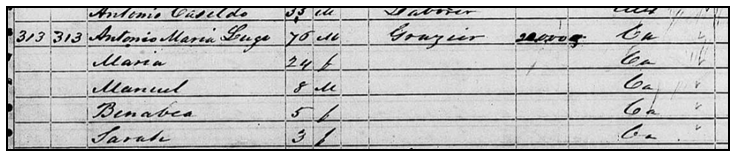
The 1850 United States Federal Census, Antonio Maria Lugo, Dwelling 313, Los Angeles County, California at Ancestry.com, Image 9 of 46.
Listed in Dwelling 310 on the same page as the family of Antonio Maria Lugo was the household of 75-year-old Anastacio Avila, a grazier who owned $2,000 of real estate. Anastacio Avila had been the Alcalde of Los Angeles after Antonio Maria Lugo and, thirty-eight years later (1888), Anastacio’s granddaughter, Victoria Avila, would be married to Felipe N. Lugo, the grandson of Antonio Maria Lugo.
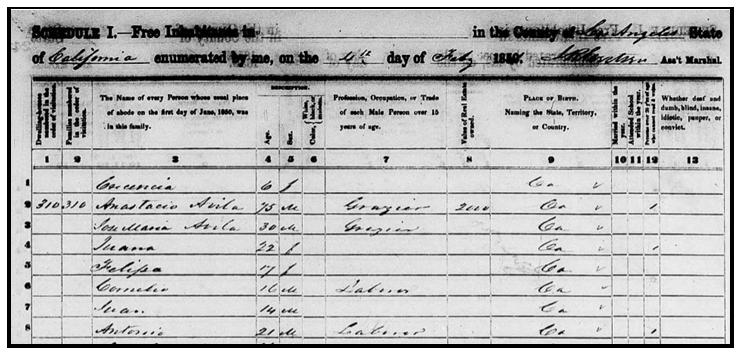
The 1850 United States Federal Census, Anastacio Avila, Dwelling 310, Los Angeles County, California at Ancestry.com, Image 9 of 46.
Living in Dwelling 514 of Los Angeles County, the 28-year-old Grazier Vicente Lugo headed a household of ten. In addition to his 23-year-old wife, Andrea, their three small children were listed as follows: Antonio M. (7 years old), Barbara (5), and Carlos (3). Also living in the dwelling were four others: Pedro Venegas (27 years old, born in Chile), Henrique Belmont (21, born in Peru), Romano Bayastero (40-year-old laborer born in California, listed as an “idiot”), and Pedro Martinez (a 25-year-old laborer born in Mexico).
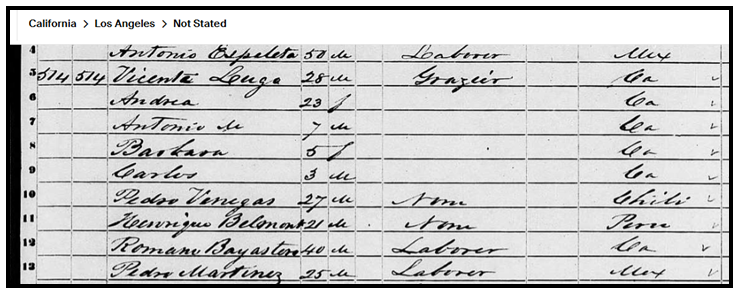
The 1850 United States Federal Census, Vicente Lugo, Dwelling 514, Los Angeles County, California at Ancestry.com, Image 46 of 46.
Antonio Maria Lugo in 1850
According to Roy Whitehead [Pages 351-352], during the early American period, “the most successful rancheros were becoming known as the ‘Cattle Barons.’” The most prominent of these cattle barons was Antonio Maria Lugo who now owned over 75,000 acres of land, most of which were filled with horses and cattle. When 1850 moved into 1851, Antonio Maria Lugo, now approaching his 73rd year, was still living on East Second and San Pedro Streets in Los Angeles. His wife was just 23 years old, and he had four young children living at home. By this time, he had sold the San Bernardino and Yucaipa Valleys for $75,000. According to Whitehead [Page 375], a government assessor in Los Angeles appraised Lugo’s San Antonio Rancho of 29,000 as being worth $72,000. As the Lugo’s sold off their San Bernardino holdings, Antonio Maria’s sons began to move their herds of cattle back to the San Antonio rancho.
Antonio Maria Lugo Partitions the Rancho San Antonio (1855)
In 1855 Antonio Maria Lugo partitioned the Rancho San Antonio —reserving a homestead for himself—among his sons, José Maria, Felipe, Jose del Carmen, Vicente and José Antonio, and his daughters, Vicenta Perez, Maria Antonia Yorba, and Merced Foster. In the case of Vicente, on June 18, 1855, Antonio Maria Lugo and his wife, Maria German de Lugo, provided a “deed of gift” to Vicente Lugo. He was provided a parcel of land totaling 4,239 acres in return for which he would pay one dollar [Deed Transfer from Antonio Maria Lugo et ux. to Vicente Lugo, at FamilySearch.org, Los Angeles County, California, Deed Records, 1854-1920, FHL Microfilm #2240121, Volume 3, Page 135, Image 151 of 844]. Antonio made similar grants to his other children around the same time.
The Lugo Family in 1860
According to Roy Whitehead [Pages 461-462], “By 1860, Los Angeles was becoming a more modernized and civilized community. Bull and bear fights in the city were outlawed.” For the previous ten years, the cattle trade and shipments of grapes and grape products were the primary source of money coming into Southern California. In 1860, there were about 78,000 head of cattle in the region around Los Angeles, of which Vicente Lugo owned 2,500 head and Felipe Lugo had another 1,000. At this time, Vicente Lugo sold his inherited parts of the San Antonio Ranch to certain parties in Los Angeles who immediately subdivided them into small lots to sell to individuals.
Meanwhile, Doñ Antonio Maria Lugo was beginning to show signs of senility. By this time, Antonio Maria, who was born in 1778, had twelve living children by his first wife (six boys and two married daughters), and four younger children by his second wife. He was still living comfortably with his 31-year-old wife, Doña Maria Antonia, and their four children ranging in age from 11 years to 17 years. His son Vicente was 38 years old and believed to be “one of the most prosperous of the Lugos and was living like a king; he had more cattle than most of the old rancheros and rode his beautiful horses around like a Beau Brummell, elegantly dressed in his Spanish regalia.”
Antonio Maria Lugo still lived in his townhouse on East Second Street and San Pedro. He had a vineyard on his property and was making his own wine and brandy. Whithead noted that Antonio Maria Lugo “rode around Los Angeles and over his Rancho Antonio in great splendor. He had never adopted American dress, culture or language, and still spoke only Spanish. He rode magnificent horses sitting on his $1,500 silver trimmed saddle erect and stately, with his sword strapped to the saddle beneath his left leg.”
The Death of Antonio Maria Lugo (1860)
On February 2, 1860, Antonio Maria Lugo died at his home in Los Angeles. His body was taken to the Catholic Church on the Plaza where his last rites were conducted and a Christian burial took place. According to La Plaza Burial #648, Antonio Maria Lugo, at age 82, had died the day after receiving the holy sacraments. The burial record is shown below.
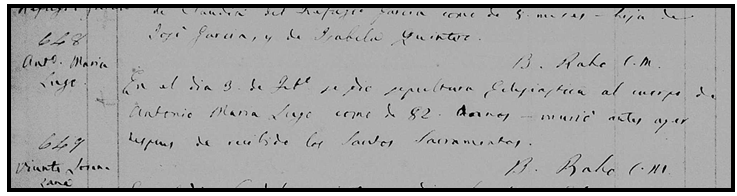
The Burial of Antonio Maria Lugo, Our Lady of Queen of Angels (La Plaza) Church Burial #648 (3 February 1860).
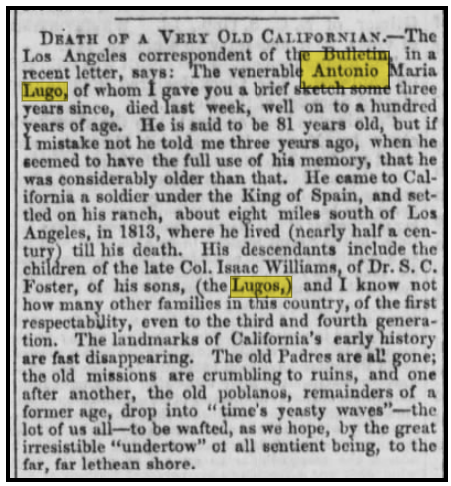
The following obituary of Antonio Maria Lugo was published in several newspapers over a period of time, including The Nevada Democrat (29 Feb. 1860), The Daily California Express (23 February 1860), and The Shasta Courier (3 March 1860), all written by the same man. However, the author states that Antonio Maria came to California as a soldier, but, in fact, he was born and baptized at San Antonio de Padua Mission in 1778. And his father, Francisco Lugo, had come from Villa de Sinaloa, not from Spain.
The Lugo Fortune Begins to Dwindle
During the American period, the Lugo fortune began to dwindle, and in 1865, most of the San Antonio Rancho was sold. (The Lugo’s did manage to retain their home in what is now known as Bell Gardens; however it was completely destroyed in 1986.) The Lugo home place was sold by the Los Angeles county sheriff in 1865 at less than $1.00 an acre. Like other Californio rancheros, Doñ Vicente Lugo saw his once-vast estates diminished in the 1850s and 1860s through high taxation, expensive litigation, and deadly drought. He still retained some power and prestige, serving as Supervisor of the Los Angeles District from 1862 to 1864. As a youth, Lugo possessed two leagues of land and ran thousands of cattle over his domain. However, by 1870, Vicente Lugo was reduced to several hundred acres surrounding his adobe in present-day Bell Gardens. Between 1870 and 1890, the entire Rancho area was divided into smaller land holdings which were then sold to the newly arriving settlers from the East.
Vicente Lugo in the 1880 Census
In 1880, the 60-year-old farmer Vicente Lugo lived with his family in the San Antonio District of Los Angeles, California. His 55-year-old wife was Andrea Lugo, and living with them were seven children, ranging in age from 34 years to 17 years. One daughter-in-law [Vicenta Lugo], two grandchildren and one adopted daughter were also listed in the household.
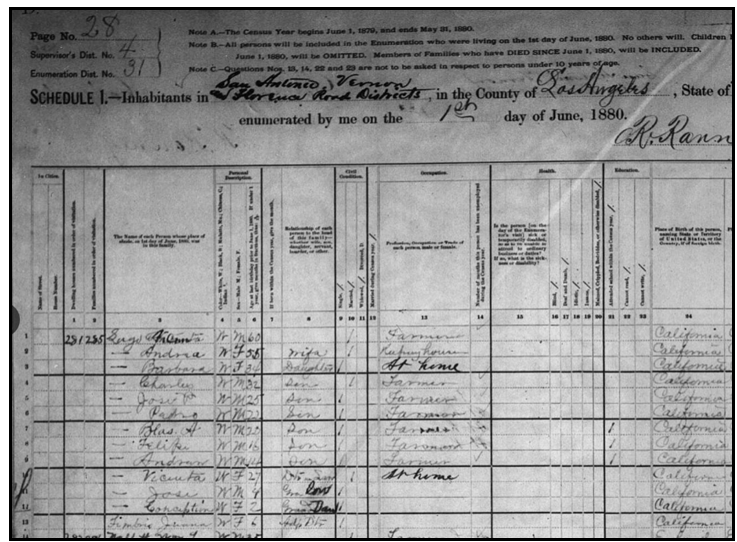
The Household of Vicente Lugo (Dwelling 281), 1880 United States Federal Census, San Antonio Districts, Enumeration District 31, Los Angeles County, California at Ancestry.com, Page 28, Image 28 of 34.
The Felipe Avila Family in the 1880 Census
Living some distance away was the family of the 47-year-old farmer Felipe Avila in the San Antonio and Wilmington Districts of Los Angeles. Felipe’s wife, Maria Prudencia Ruiz, had died on January 5, 1880, so Felipe was now a widower. Eight children ranging in age from 20 years to 5 years lived with Felipe. All members of the household were born in California, but Felipe’s father was born in Mexico. The third-oldest daughter, Victoria Avila, was 15 years old and would be married eight years later to Felipe Lugo, the son of Vicente.
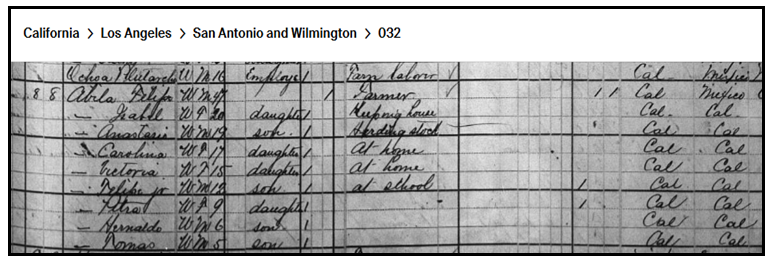
1880 United States Federal Census, San Antonio and Wilmington Districts, Enumeration District 32, Los Angeles County, California at Ancestry.com, Page 1, Image 1 of 1.
Felipe Avila’s father was Jose Anastacio Avila, who had been born around 1776 in El Fuerte, Sinaloa. The Mexican Governor had granted him 3,599 acres to him by 1843. The grant was called Rancho La Tajauta, which extended from the marshes along present-day Alameda Street westward to the present-day north-south line of the Harbor Freeway in South Central L.A. Anastasio Ávila was one of several sons of Cornelio Ávila, who had first come to California in 1783. Cornelio had first settled at Los Angeles but moved on to Santa Barbara in 1797, dying in 1800. Cornelio Avila was Nicci Lugo’s earliest known Avila ancestor as noted in the following descendancy chart.
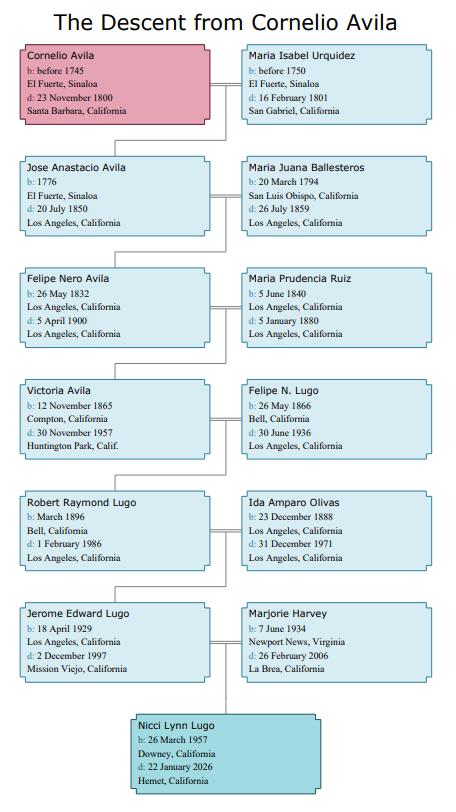
The Descent from Cornelio Avila to Nicci Lugo (Seven Generations).
The Death of Vicente Lugo (1890)
On February 25, 1890, 69-year-old Vicente Lugo died at his San Antonio Ranch. His certificate of death [available through the Findagrave.com Memorial #156577431], has been reproduced below.
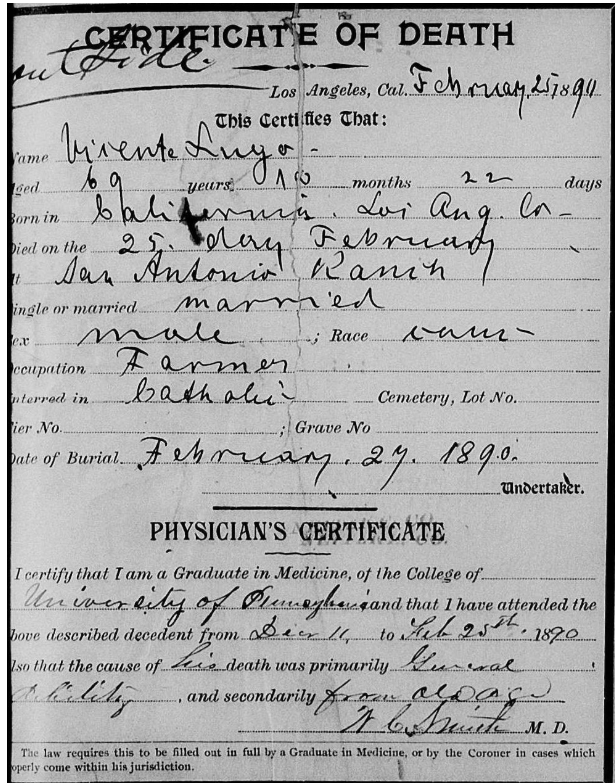
Vicente Lugo Certificate of Death (25 February 1890)
Several obituaries for Vicente were published in the local newspapers. The Los Angeles Times obituary entitled “An Old Timer: Death of the Aged Don Vicente Lugo,” [26 February 1890] reported that Vicente “died after being confined to his bed only a few weeks.” The article referred to him as “the last of the big family of children left by old Don Antonio M. Lugo.” Don Antonio M. Lugo was “considered the wealthiest man in California” but the article erroneously stated that he “came here from Spain when quite a boy as a soldier.” The belief that Antonio came from Spain was a widely-held misconception, but, in fact, he was born in San Antonio de Padua Mission. One of Vicente’s obituaries was written by the Los Angeles Herald [26 February 1890] and has been reproduced below:
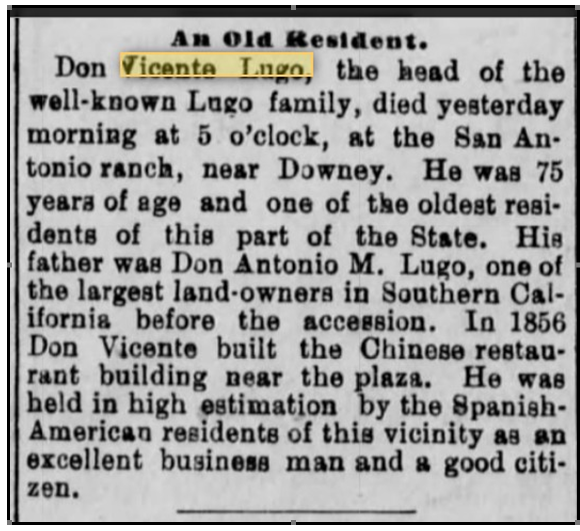
Vicente Lugo Obituary: “An Old Resident,” Los Angeles Herald, 26 February 1890.
The Death of Andrea Ballesteros de Lugo (1897)
On June 20, 1897, Andrea Ballesteros de Lugo, the wife of Vicente, died. According to her certificate of death [available through the Findagrave.com Memorial #197206066], she was 71 years old and died from tuberculosis. She had been under a physician’s care for about a year-and-a-half.
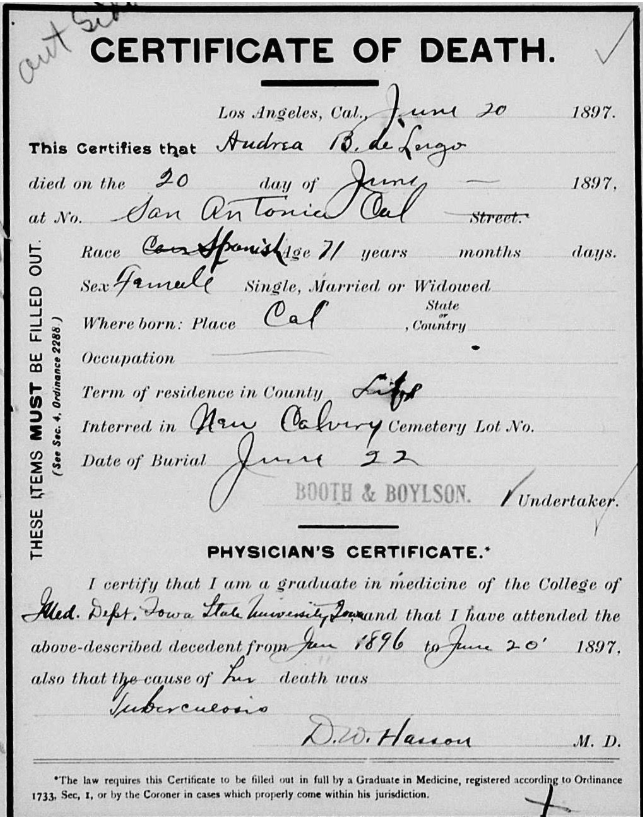
Certificate of Death for Andrea B. de Lugo (20 June 1897).
The Fourth Generation in California: Felipe N. Lugo (1866-1936)
On May 26, 1866, Felipe N. Lugo was born in the Lugo family’s adobe house near Bell, California. At the time, his father, Vicente Lugo, was 43 years old and his mother, Maria Andrea del Carmen Ballesteros, was 38 years of age. Felipe Lugo returned to ranch life after finishing his education and, with his two brothers, Andrew and Pedro, he carried on a prosperous business of raising and training fine carriage and racing stock. Felipe became one of the best known men in that business in this part of the state.
On August 17, 1888, Felipe Lugo was married to Victoria A. Avila in Los Angeles, California. On the next day, the Los Angeles Evening Express announced that a marriage license had been issued to F.N. Lugo, a native of California and resident of San Antonio, age 24, to marry Victoria Avila, also a native of California and resident of Compton, aged 24. However, the actual marriage license stated that Victoria Avila was 22 years old. The marriage license has been reproduced below.
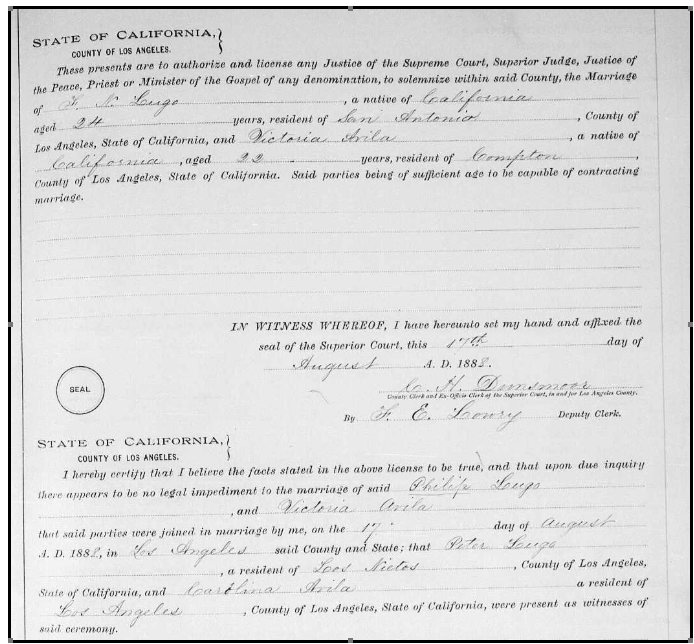
Felipe N. Lugo and Victoria Avila Marriage License, Los Angeles County, August 17, 1888 at FamilySearch.org, FHL Microfilm 1033137, Item 4, Page 211, Image 109 of 165.
The Felipe Lugo Family in the 1900 Census
Felipe Lugo and Victoria Avila were the parents of at least five sons and five daughters. By the time of the 1900 census, 36-year-old Felipe Lugo was living in the Fruitland District of Los Angeles, a heavy industrial region currently in the Los Angeles/Vernon [now in Zip Code 90058]. His occupation was “cattle driver.” Felipe stated that he was born in May 1864 and had been married to 33-year-old Victoria A. Lugo for twelve years. Victoria [Avila] Lugo stated that she had been born in November 1866 and had given birth to six children, of which five were still living in 1900. Together, Felipe and Victoria Lugo had five children at home ranging in age from 10 years to 10 months. The 1900 census schedules for this family has been reproduced below:
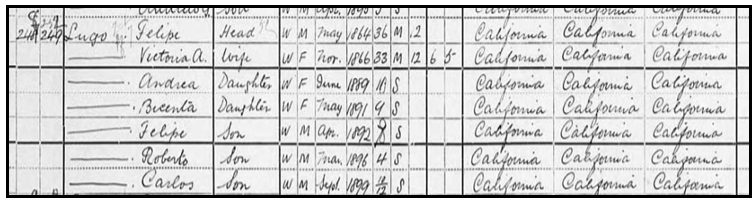
Household of Felipe Lugo, 1900 United States Federal Census, Dwelling 247, San Antonio Township (Fruitland District), Enumeration District 123, Los Angeles County, California, Sheet 36A at Ancestry.com, Image 71 of 78.
The Death of Felipe Lugo (1932)
Felipe Lugo died on June 20, 1932, aged sixty-six years, and his funeral was conducted from Our Lady Queen of Angeles Church, where four generations of the family had worshipped. In an article entitled “Obsequies Tomorrow for Lugo,” The Los Angeles Times reported that “members of some of the oldest Southern California families will carry the body of Felipe Lugo, grandson of the original owner of the once vast San Antonio Rancho, to its final resting place.”
The pallbearers were to be Angel Yorba, Felipe Avila, Ramon Carrillo, Reginaldo Castillo, Heraldo Guzman and Jose Maria Arguello. Lugo had died of a heart attack at his home at 344 East 35th Street. The article also stated that, “In his earlier years, he [Felipe] was noted for his ability as a trainer of race horses and as a horse-breeder.” He left three daughters, Andrea, Esigora and Martha, and three sons, Felipe, Roberto and Tomas. The Fresno Bee [22 June 1932] published an obituary entitled “Felipe Lugo, Scion Of Early Spanish Family, is Dead.” It stated that the original San Antonio Rancho had “held the territory now covered by the towns of Bell, Belvedere, Montebello, Downey, Florence and part of Watts.”
Victoria Avila
When Victoria A. Avila was born on 12 November 1865, in California, her father, Felipe Nero Avila, was 33 and her mother, Maria Antonia Prudencia Ruiz, was 25. She survived her husband, Felipe Lugo, by 25 years, dying on 30 November 1957, in Bell Gardens, Los Angeles, at the age of 92. Her obituary was published in The Los Angeles Times on December 3, 1957. It has been reproduced below:
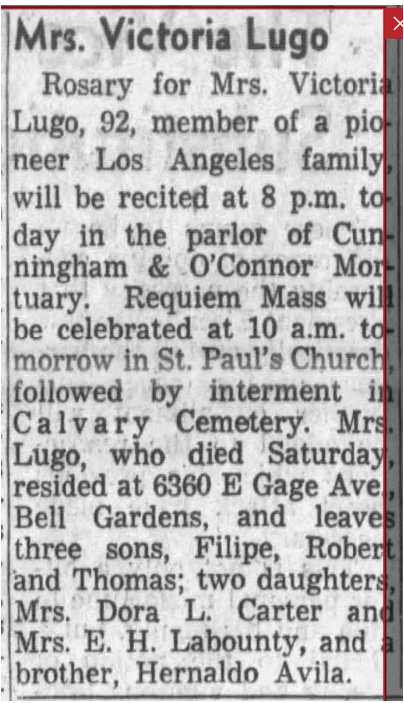
The Obituary of Mrs. Victoria Lugo, The Los Angeles Times, 3 December 1957, Part III, Page 3 from Newspapers.com.
The Fifth Generation in California: Robert Raymond Lugo (1896-1986)
When Robert Raymond Lugo was born on 15 March 1896, in Los Angeles, California, his father, Felipe N Lugo, was 32 and his mother, Victoria A. Avila, was 30. On June 15, 1917, during World War I, Robert Raymond Lugo registered for the draft in Pima County, Arizona. He gave his birthdate as March 15, 1896 and said that he was born in Los Angeles. At the time, he was employed as an “auto truck driver” for Narragansett Mines Company. He was not yet married. Physically, he was described as tall with dark brown hair and dark brown eyes.
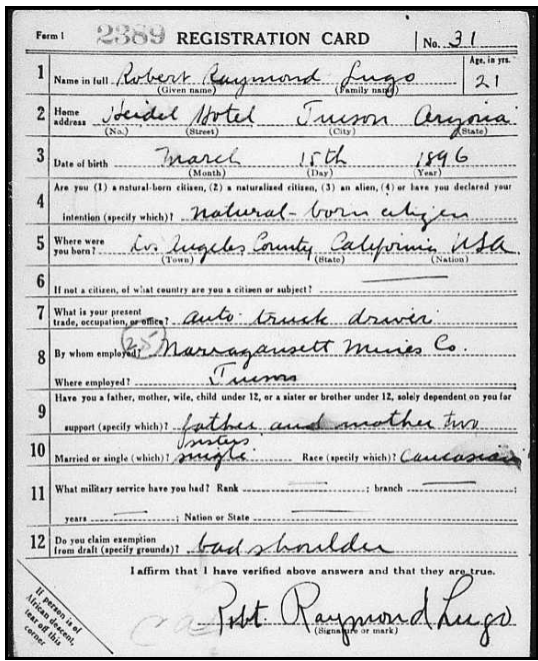
Robert Raymond Draft Registration, U.S., World War I Draft Registration Cards, 1917-1918, Pima County, Arizona, Draft Card L, at Ancestry.com, Image 404 of 440.
The Marriage of Robert R. Lugo and Ida Amparo Olivas (1922)
On April 21, 1922, when Robert R. Lugo was 26, he was married to 31-year-old Ida A. Olivas. Both were from Los Angeles. Robert was an auto mechanic and the son of Felipe N. Lugo and Victoria Avila. Ida was the daughter of Bartolo Olivas (from Mexico) and Mary Ballerino (a native of California). Their certificate of Marriage from Los Angeles County has been reproduced below:
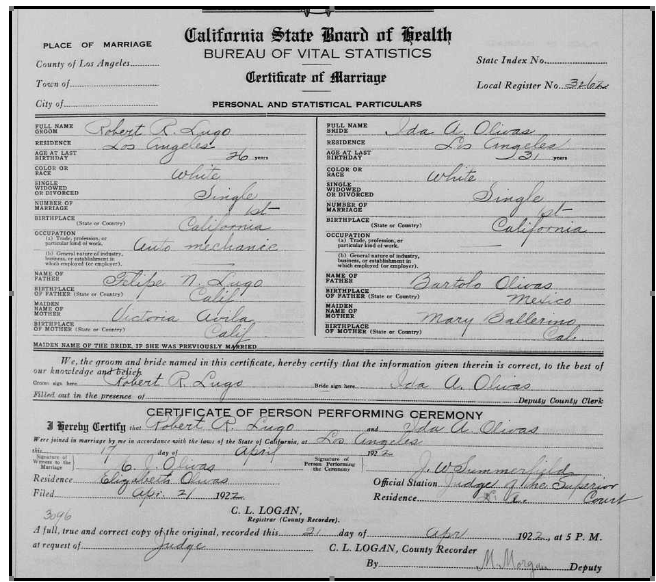
Certificate of Marriage, Robert R. Lugo and Ida A. Olivas, 21 April 1922, in FamilySearch.org, FHL Microfilm 2074277, Item 3, Los Angeles. Marriage Licenses April 1922–June 1922, Page 43, Image 47 of 408.
The Origins of Ida Amparo Olivas
Jerome Edward Lugo, the father of Nicci Lugo, was descended through his father (Robert Raymond Lugo) from one of California’s well-known and privileged families that had been firmly established in California since 1774. However, through his mother, Ida Amparo Olivas, he was descended from more recent immigrants with their origins in Chile and two cities in Sonora, Mexico: Ures and Guaymas.
When Ida Amparo Olivas was born on 23 December 1888 in Los Angeles, her father, Bartolo N Olivas, was 37 and her mother, Maria Ballerino, was 23. In the 1900 census, 11-year-old Ida Olivas lived with her parents at 321 Bauchet Street in Los Angeles. Ida’s 41-year-old father, Bartolo Olivas, was born in Mexico in August 1858 [an incorrect date] and was a barber. He had come to America in 1866, 34 years earlier. His 36-year-old wife, Maria [Ballerino] gave her birth date as March 1864 and was a native of California. However, her father was born in Italy, and her mother was born in Mexico. In reality, Maria’s father had actually come from Chile, not Italy. Bartolo and Maria had been married for 14 years, and Maria had given birth to seven children, of which six were living in 1900.
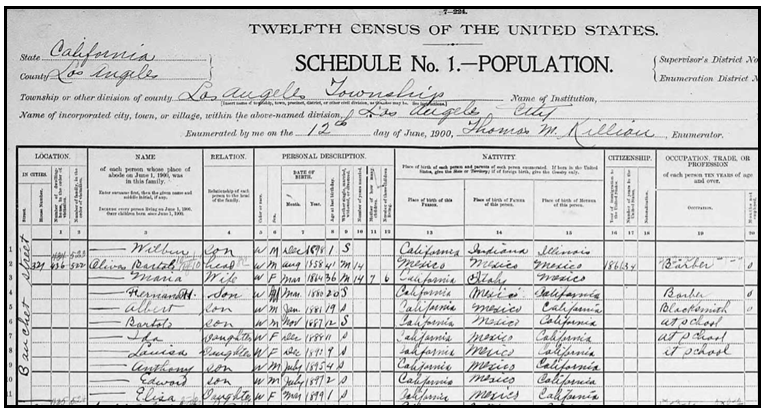
Dwelling 436, The Household of Bartolo Olivas, 1900 United States Federal Census, Los Angeles Township, Enumeration District 83, Los Angeles County, California, Sheet 20A at Ancestry.com, Image 39 of 48.
Living in another part of Los Angeles were Maria Ballerino’s parents, 72-year-old Barleto [Bartolo] Ballerino and his 63-year-old wife wife, Maria [Amparo] Ballerino. Bartolo stated that he had been born in 1828 but said his birthplace was “Unknown.” He stated that he immigrated to the U.S. in 1849 and his occupation was “capitalist.” He had been married to his wife for 44 years (1856) and she had given birth to ten children, all of whom were still alive. She also listed her place of birth as “Unknown.” However, it is known that Bartolo came from Chile, and his wife came from Mexico. Several children lived with them, and some of them claimed that their father was born in Peru and that their mother was born in California or Mexico.
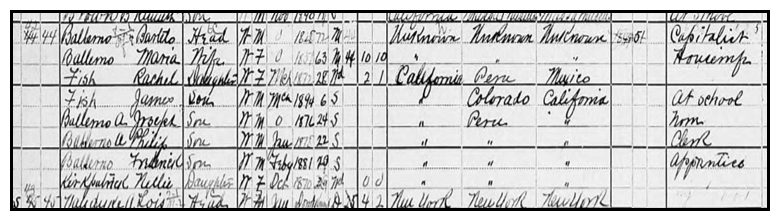
Dwelling 44, Household of Barleto Ballerino, 1900 United States Federal Census, Los Angeles Ward 4, Enumeration District 44, Los Angeles County at Ancestry.com, Sheet 3A, Image 5 of 47.
Bartolo N. Olivas And His Wife
On December 14, 1938, Bartolo Olivas filed his Declaration of Intention to become an American citizen. He stated that he was an 87-year-old retiree and had been born in Ures, Sonora, Mexico on August 24, 1851. Ures was only about 110 miles south Nogales at the Mexican-U.S. border. He stated that he had entered the United States at Nogales, Arizona, around 1867. On February 5, 1943, he filed Petition for Naturalization #104494.
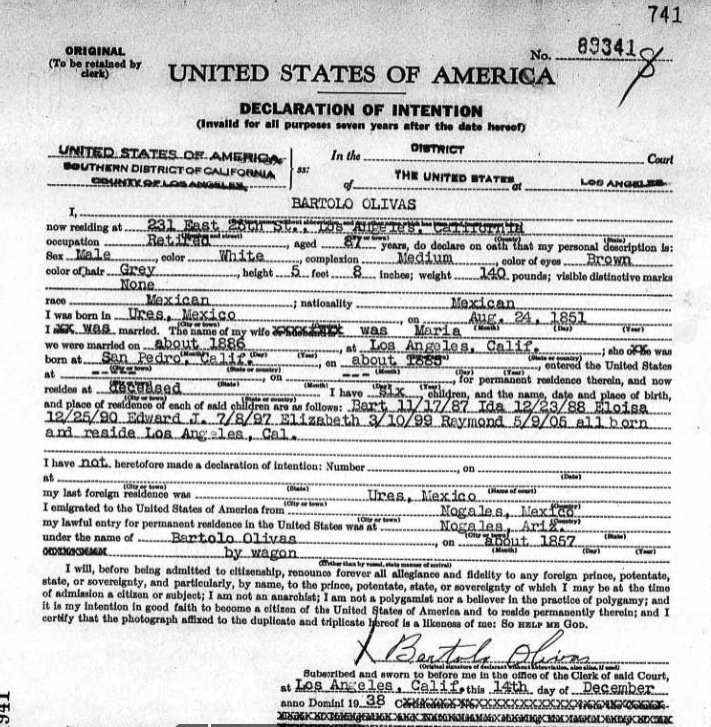
Bartolo Olivas “Declaration of Intention #89341,” U.S., Naturalization Records, 1840-1957, at Ancestry.com, California District Court (Roll 052), Declarations of Intention 145-146; 88601-90200; 11∕19∕38-1∕30∕39, Image 760 of 1634.
Two years after his naturalization petition, on July 25, 1945, Bartolo N. Olivas died in Los Angeles. On his Los Angeles certificate of death, Bartolo’s date of birth was given as August 24, 1851 in Ures, Sonora, Mexico. He was the son of Juan Olivas and Carmen Muñoz.
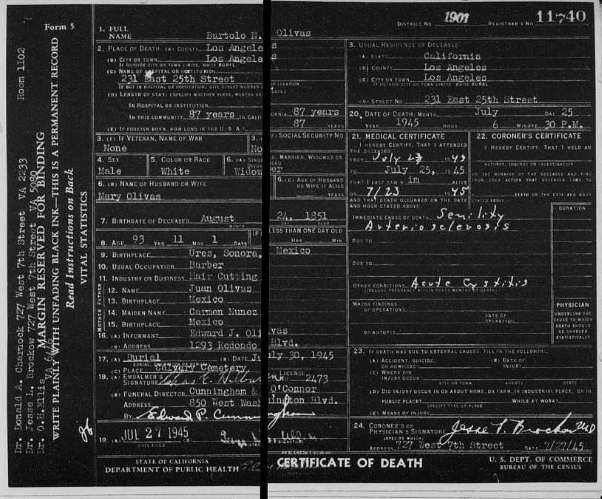
Bartolo N. Olivas Certificate of Death at FamilySearch.org, FHL Microfilm #2368690, Los Angeles, Death Certificates, 1945, Image 619 of 2,765.
Seven years earlier, on June 13, 1938, Mary B. Olivas, the spouse of Bartolo Olivas, had died in Los Angeles at the age of 73 years, 3 months, and four days. Her Certificate of Death revealed that she had been born on March 9, 1865 in Los Angeles to Bartolo Ballerino (a native of Chili) and Amparo Moreno (a native of Guaymas, Sonora, Mexico).
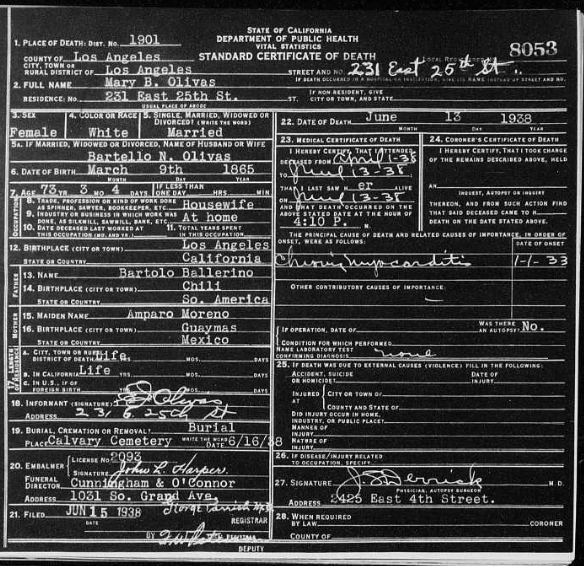
Certificate of Death #8053 (13 June 1938), Mary B. Olivas, at FamilySearch.org, FHL Microfilm #2379437, Los Angeles. Death Certificates 1938, Image 47 of 2,883.
The Colorful Life of Bartolo Ballerino
Jerome Lugo’s maternal great-grandfather, Bartolo Ballerino, was a colorful character. The Lake Elsinore Valley Sun-Tribune of May 21, 1909 published an article entitled “King of Los Angeles’ Chinatown Found Dying in Squalid Shack,” The article stated that “Bartolo Ballerino, proprietor of the buildings in Chinatown known as ‘cribs’ and one-time king of the redlight district of Los Angeles, was taken from his home on Alameda Street last night, suffering from a complication of diseases and in a most serious condition.” For some time, Ballerino had “reigned absolute and undisputed in the lower world of this city and his houses, which were used for immoral purposes, were known the world over.”
However, five years earlier, “Ballerino’s power in civic affairs began to decline, and one by one his friends dropped away from him.” He was the father of nine children, but had separated from his wife some years earlier. The article also noted that he had “accumulated a great deal of property in his prosperous days as king of the redlight district.” In fact, he was reputed to be worth three-quarters of a million dollars. However, his divorce had forced him to divide his large holdings with his ex-wife and in his last two years, Ballerino had been “living in one of his squalid little shanties in the old crib district.” A month later, on July 11, 1909, Bartolo Ballerino died. His Certificate of Death confirmed that he was born in 1829 in Chile, but the names of his parents were not known by the next-of-kin. The death certificate follows:
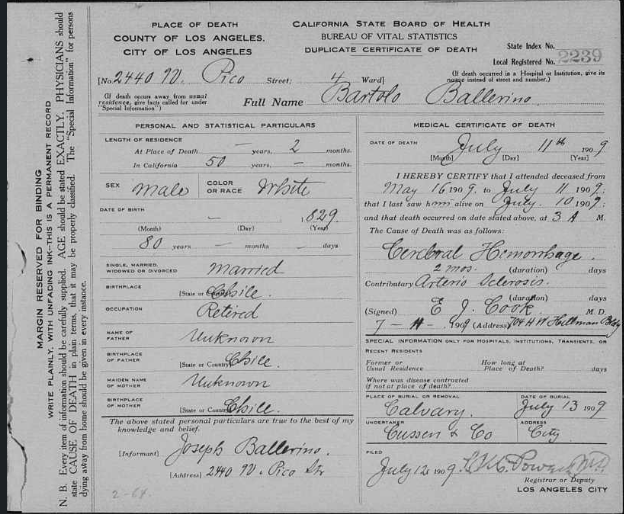
Certificate of Death, Bartolo Ballerino, at FamilySearch.org, FHL Microfilm #2368690, Los Angeles, Death Certificate, 1908, Image 2543 of 2557.
The Aftermath of Bartolo Ballerino’s Death (1909)
On July 12, 1909, The Los Angeles Times published an obituary entitled “Ballerino, Old Crib King, Dies.” Known as the “Emperor of Chinatown,” Bartolo Ballerino was over 80 years of age and was “one of the most notorious characters in the Southwest.” His property had an estimated value of about $200,000, most of it in real estate and stocks and bonds.
Bartolo Ballerino was full of surprises, even in death. According to The Los Angeles Herald [July 14, 1909], Ballerino’s final estate was valued at $250,000. He left $5 to each of his nine children, ranging in age from 28 to 55 years. He bequeathed the bulk of his estate to Della Queen, formerly Leila Garrison, who had “nursed Ballerino during his declining years.” Della was also named as Ballerino’s executor.
The Sixth Generation in California: Jerome Edward Lugo (1929-1997)
Jerome Edward Lugo was born on April 18, 1929 in Los Angeles as the son of 33-year-old Robert Raymond Lugo and 44-year-old Ida Olivas, both residing in Los Angeles. His birth certificate from Los Angeles County follows:
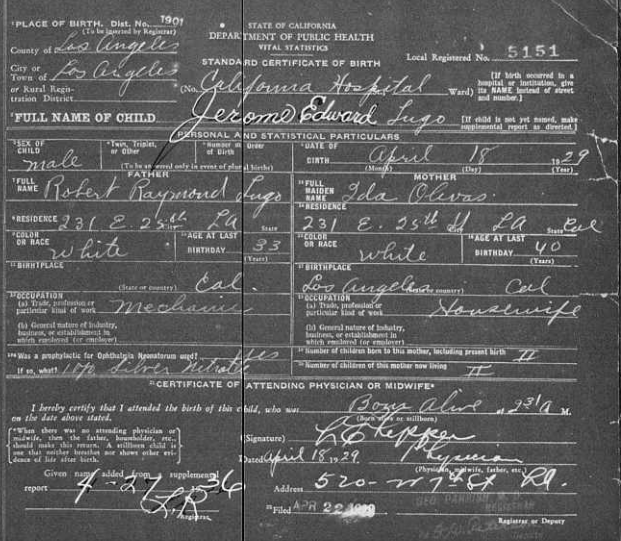
Jerome Edward Lugo Birth Certificate (18 April 1929), at FamilySearch.org, FHL Microfilm #225194, Los Angeles County Birth Certificates (1929), Image 1760 of 3,142.
Jerome Lugo in the 1940 Census
In the 1940 census, 12-year-old Jerome Lugo was living with his parents and his maternal grandfather at 231 25th Street in Los Angeles. He was attending school at the time. The head of household was the 87-year-old widower, Bartolo Olivas, a native of Mexico. His daughter Ida Lugo was now 52 years old and a native of California. Ida’s husband, Robert Lugo, was 48 years old and employed as a mechanic. There were also four Olivas children in the household, ranging in age from 52 years old (Ida) to 31 years old. There were also two grandsons, Robert Lugo (13 years old) and Jerome Lugo (12 years old).
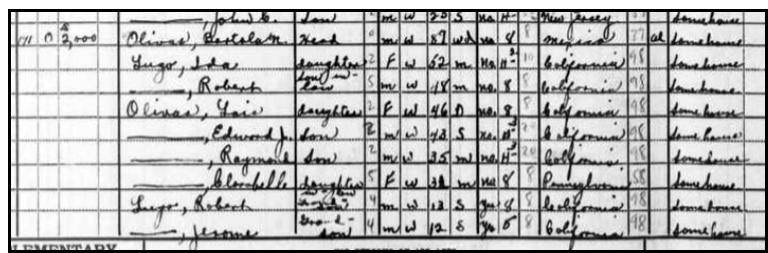
The Household of Bartolo N. Olivas, 1940 United States Federal Census, Los Angeles Township, Enumeration District 60-798, Los Angeles County, California, at Ancestry.com, Sheet 7A, Image 13 of 28.
On August 12, 1952, Jerome Edward Lugo was married to Marjorie Lee Harvey at Post Chapel in Baltimore Maryland. It was noted that the bride’s father was an air force officer. Their marriage record has been reproduced below.
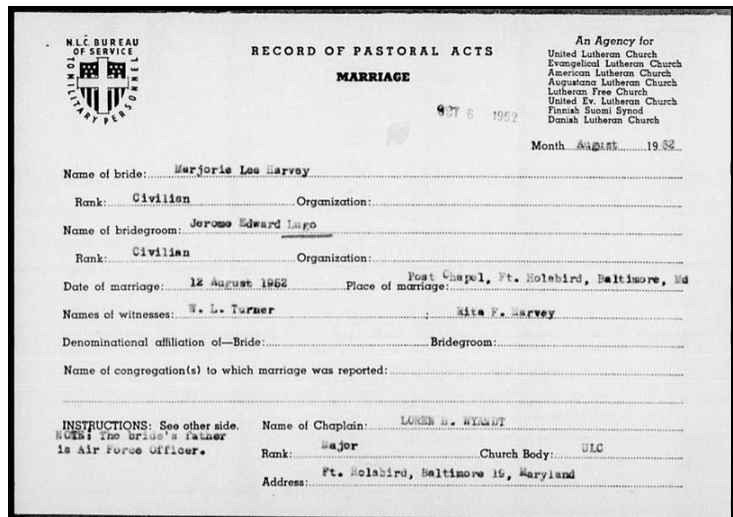
U.S., Evangelical Lutheran Church in America Church Records, 1781-1969 at Ancestry.com, National Lutheran Council Roll No. 15: Pastoral Acts: 1949-1954 Gate, Margie Ellen – Mayer Hoffer, Oscar, Image 2228 of 2745.
Jerome and Marjorie Lugo had five children from 1955 to 1966. Unfortunately, two of the children died at a very young age. Eventually, Jerome and Marjorie (known as Monnie) were divorced in August 1970 in Los Angeles.
Notable Deaths in Family
Jerome’s paternal grandmother, Mrs. Victoria [Avila] Lugo had survived her husband, Felipe Lugo, by 25 years, dying on 30 November 1957, in Bell Gardens, Los Angeles County, at the age of 92. Her obituary was published in The Los Angeles Times on December 3, 1957. The obituary mentioned that Victoria was a “member of a pioneer Los Angeles family.” Her funeral mass was celebrated at St. Paul’s Church. She was survived by three sons, Felipe, Robert, and Thomas; two daughters, Mrs. Dora L. Carter and Mrs. E. H. Labounty; and a brother, Hernaldo Avila.
On January 3, 1972, The Los Angeles Times reported that Ida A. Lugo, “beloved wife of Robert R. Lugo, Sr., loving mother of Jerome and Robert Lugo, Jr.,” had died. She was survived by six grandchildren. Her funeral mass took place at St. Vincent Church.
On February 1, 1986, The Los Angeles Times reported that Jerome’s father, Robert R. Lugo, the “beloved father of Robert, Jr. and Jerome Lugo” had died. He was also survived by two brothers, two sisters, six grandchildren and eight great-grandchildren. Jerome Lugo died on December 2, 1997 in Mission Viejo, Orange County, California.
The Death of Monnie Lugo (2006)
On February 24, 2006, The Press-Enterprise announced the death of Marjorie (Monnie) Lee Lugo. She had been born on June 7, 1934 in Newport News, Virginia to her parents, Colonel Marvin M. and Mrs. Marjorie L. Harvey. She married Jerome Edward Lugo in 1952. Through that marriage she had five children: Lori, Nicci, Toni, Jerry, Lee and Michael. Monnie was a waitress for 30 years. Through her waitress job, Monnie met her second husband, Timothy Jenkins, whom preceded her in death. At the time of her death in 2006, she was survived by her children, Lori, Nicci, Toni; her baby sister Rita Becker; 12 grandchildren, 10 great-grandchildren and many extended family members and friends. A Memorial Service was held at the Hemet Valley Mortuary.
The Death of Nicci Lugo (2026)
In January 2026, Nicci Lugo died in Riverside County, California at the age of 68 years. It is believed that the extended Los Angeles Metropolitan Area has an estimated population of about 13 million. Of those people living in L.A. and the rest of Southern California, Nicci Lugo was one of the few people who had extensive ties to many of the founding families of the Los Angeles-Santa Barbara area: Lugo, Avila, Ballesteros, Ruiz, Ybara, Figueroa, Sepulveda, Redondo, and Lorenzana. These are not only the names of founding families but they are also the names of many streets throughout the Southland. This article has highlighted the Lugo family in particular because that is the surname she carried for her entire life, but Nicci had many other ancestors who contributed greatly to the Los Angeles and Santa Barbara communities. Nicci Lugo was truly a pioneer daughter of Los Angeles.
Primary Sources:
Mason, William M. Los Angeles Under the Spanish Flag: Spain’s New World. Burbank, California: Southern California Genealogical Society, 2004.
Whitehead, Roy Elmer, Lugo: A Chronicle of Early California. Redlands, California: San Bernardino County Museum Association, 1978.