

Toltecness: Tollan and the Toltecs in the Codex Xolotl and Historia de la Nación Chichimeca
by Guest Author: RICARDO GARCÍA MEDINA.
The following essay is Chapter 13 of Lenguas yutoaztecas: historia, estructuras y contacto lingüístico, Homenaje a Karen Dakin edited by Rosa H. Yañez Rosales.
Introduction
The Nahuas employed a logosyllabic writing system to write works like the Codex Xolotl, but accessing the repertoire of meanings in this work requires consulting Fernando de Alva Ixtlilxochitl whose Historia de la Nación Chichimeca references it, and Alonzo de Molina whose dictionary presents a large number of words used by Nahuas during the early colonial period. Such a process can lead to contextualizing the graphemes, their meanings, and their relationships to each other in the Codex Xolotl. As a result, this essay examines the top-left corner of the first folio of the Codex Xolotl, a portion that Thouvenot (1987: 84-86) quantified as X.010, which has three scenes –a northeastern one, an eastern one, and northwestern one – containing groups of graphemes that include a Toltecatl/Toltecah glyph, close to two conversations between the characters of Xolotl and Nopaltzin. It argues that Ixtlilxochitl utilized these scenes to compose the part of Chapter 4 of the Historia de la nación Chichimeca in which he presents the arrival of Xolotl from the north to an area that contained ruins left behind by the Toltecs. As a result, the other graphemes in the aforementioned scenes of the Codex Xolotl represent depopulation, Toltec territory, and the city of Tollan. Finally, the paper proposes that variations within the Toltecatl/Toltecah and other graphemes suggest that the northeastern and eastern scenes were composed by one tlacuilo (scribe), whereas the northwestern scene was created by another.
1. The Aztec Empire and the Codex Xolotl
Like rulers throughout Eurasia, the rulers of the Aztec Empire commissioned written documents for different purposes.[1] One of these works has become known as the Codex Xolotl, which scholars have connected to the Acolhua of Tetzcoco, one of the Nahuatl-speaking groups (Nahuas) that created the Aztec Empire.[2] The Acolhua-Nahua employed a logosyllabic system to record utterances in Nahuatl about themselves and their ancestors in the Codex Xolotl that may rival the Iliad in complexity. However, understanding of the Codex Xolotl remains a work in progress because even though more and more of the graphemes, the visual symbols of language in this work have been decoded, the understanding of their relationships is only beginning.[3]
A logosyllabic system is more difficult to decode than more phonetic systems because it is invariably connected to art. However, Pierre Bourdieu (1993: 215) offers a solution in his statement that “art perception involves a conscious or unconscious deciphering operation,” so that “an adequate comprehension [of an object of art] is possible and effective only in the special case in which the cultural code…is immediately and completely mastered by the observer.”[4] Unfortunately, the Codex Xolotl is no longer connected to the literate community that created it, but the works of Nahua, European, and casta writers offer valuable data that capture pieces of its cultural code.[5]
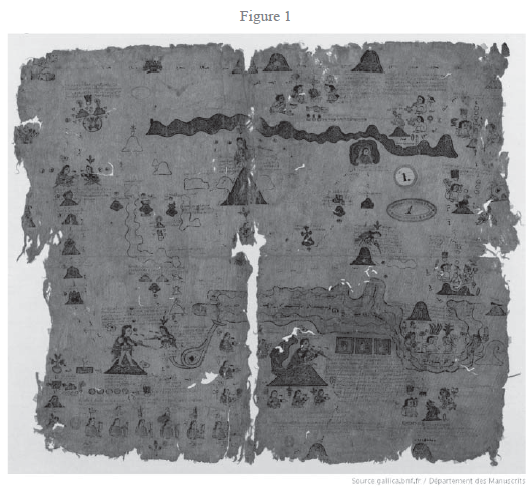
The first folio, X.010 according to Thouvenot (1987: 84-86), refers to Xolotl and Nopaltzin, two Acolhua leaders.[6] According to Jerome Offner (2014: 33), Xolotl and Nopaltzin are prominent in works by colonial chronicler Alva Ixtlilxochitl who referenced the Codex Xolotl in his accounts. Ixtlilxochitl thus read or relied on people who could read the Codex Xolotl in whole or in part. Can Alva Ixtlilxochitl serve as a guide to understanding the “cultural code” of the logosyllabic writing in the Codex Xolotl? In the following essay, I present evidence that addresses the “cultural code” of the Codex Xolotl by relying on Central Nahuatl as recorded by Alonzo de Molina and Spanish-language content from Ixtlilxochitl’s Historia de la Nación Chichimeca, proposing the existence of two graphemes in interactions between Xolotl and Nopaltzin. The first is a polihui logogram that means “to be disappeared” or “to be desolated” and a Tollan2 phonogram from tolontic, roundness, that represents Tollan, arguably the most important city-state in pre-contact Mesoamerica.
2. Central Nahuatl, the Codex Xolotl, and its Literate Community
Since alphabetic Nahuatl is being used as a bridge to uncover meaning in logosyllabic Nahuatl, it is necessary to understand the strength of this conduit. The alphabetic Nahuatl recorded in and around the Basin of Mexico during the sixteenth and seventeenth centuries represented a “Central Nahuatl” language of literate individuals in alphabetic Nahuatl who were in close contact with Spanish speakers.[7] As a result, Central Nahuatl changed to some degree due to the influence of Spanish.
Lockhart proposes four stages of change. Stage 1 represents the first generation of contact, ca. 1519-1545, when Nahuas primarily used their own language to classify new objects and customs introduced by Europeans.[8] Stage 2 began between 1545-1570 and was characterized by the borrowing of numerous Spanish nouns, and its community included Molina and other writers of alphabetic Nahuatl, whereas Stage 3 started during the first half of the seventeenth century and was characterized by the incorporation verb loans.[9] Bartolomé de Alva wrote A Guide to Confession Large and Small in the Mexican Language, 1634 and Chimalpahin wrote Las Ocho Relaciones y el Memorial de Colhuacan, so both fall under Stage 3. No sources by Ixtlilxochitl in alphabetic Nahuatl have survived, but his Spanish-language works should be classified as belonging to Stage 3 since he includes terms in Nahuatl that were no doubt influenced by his associations with Bartolomé de Alva, his brother, Chimalpahin, his colleague, and other individuals literate in alphabetic Nahuatl.
The use of alphabetic Nahuatl from Stage 3 may make Ixtlilxochitl, Bartolomé de Alva, and Chimalpahin the students of the author who wrote the alphabetic gloss of the first folio of the Codex Xolotl, X.010 (Figure 1). Charles E. Dibble (1951: 12) observes that the alphabetic gloss does not match Ixtlilxochitl’s calligraphy, theorizing that alphabetic components were written by either the tlacuilo (scribe) who copied it during the sixteenth-century, or a subsequent writer who wrote before the completion of Fernando de Alva Ixtlilxochitl’s Historia de la nación Chichimeca. Gordon Whittaker (2016: 57) offers the possibility that Alva Ixtlilxochitl may have commissioned someone to write the alphabetic gloss by positing:
…the historian [Alva Ixtlilxochitl] acquired his knowledge of Pre-Hispanic traditions less from hearth and home during his childhood and adolescence than from a careful adult reliance on manuscript sources and on consultations with select contemporaries possessing the information he sought.
Stage 2 Nahuatl was characterized by the almost exclusive borrowing of nouns from Spanish to Nahuatl (Lockhart, 1992: 264; 284). However, the alphabetic gloss in X.010 of the Codex Xolotl does not have any Indo-European words: from Castilian Spanish, Latin, or any other variant.[10] Does this usage represent the presence of Stage 1 Nahuatl, or did the alphabetic writer make a conscious decision to avoid Indo-European words? The second probability is more likely since the author of the alphabetic gloss did not use teocalli (temple), which is common during Stage 1, relying on tiopan (temple) which was common during and after Stage 2.[11]
The four stages theorized by Lockhart aid in understanding changes in Nahuatl due to contact with Spanish, and investigations into Central Nahuatl suggest the presence of a mutually intelligible Nahuatl from before the fall of the Aztec Empire until the seventeenth century. Given these two propositions, the Nahuatl contained within the Codex Xolotl and the Nahuatl employed by Ixtlilxochitl and Molina can serve as a bridge to logosyllabic meanings in the Codex Xolotl.
Robertson (1959: 68-71, 134-135) proposes that two important schools of Mesoamerican logosyllabic writing existed in the Basin of Mexico during the early colonial period: one centered in Mexico-Tenochtitlan and another in Tetzcoco. Alfonso Lacadena (2008a: 6) theorizes that writers from Tenochtitlan and Tetzcoco relied on a common repertoire of logosyllabic graphemes, but that those from Tetzcoco favored a greater use of syllabic graphemes than those from Tenochtitlan. Whittaker (2009: 72-73) disagrees, presenting examples from Tenochtitlan with phonetic compounds and positing that the arrival of Europeans influenced Indigenous writers from both Tenochtitlan and Tetzcoco to employ greater phoneticity.
Scholars have examined whether the logosyllabic graphemes used in the Codex Xolotl were taken from a pre-contact repertoire. Walter Lehman (apud Douglas 2010: 25, 204) proposes that the Codex Xolotl was a copy of a Pre-Columbian work, and Thouvenot (1987: 28-29), Robertson (1994: 37), Douglas (2010: 25), and Offner (2016: 83) agree. Thouvenot (1987: 28-29) places it between 1429 and 1608 based on comments by Ixtlilxochitl and other writers, ultimately de-emphasizing the importance of a date of creation. Meanwhile, Robertson (1994: 143) dates it before the Quinatzin or Tlohtzin manuscripts, which Douglas (2010: 25) asserts were probably created during the 1540s. Offner (2016: 83) suggests that the Codex Xolotl was not one document but a collection of documents based on predecessor documents gathered and probably repurposed in the immediate aftermath of the fall of the Aztec Empire.
These dates of creation suggest that the logosyllabic writing of the Codex Xolotl preserves either a pre-Columbian or Stage 1 variety of Central Nahuatl. Thouvenot (1987) wrote a comprehensive dissertation on the graphemes of the Codex Xolotl, and he did not find any that recorded a Spanish morpheme, word, or larger utterance. Joaquín Galarza (apud Lockhart 1992: 332) presented ways in which Indigenous writers adapted graphemes from their logosyllabic repertoire to record Spanish words such as Francisco, Domingo, Esteban, and Clara, but none of these are found in the Codex Xolotl. The lack of logosyllabic graphemes to represent Spanish or Latin is an indication that the writers of the Codex Xolotl were recording pre-Columbian or Stage 1 Nahuatl; or that they made conscious efforts not to use any Indo-European loan words.
The writers of the Codex Xolotl used two types of graphemes – logograms and phonograms – to record pre-Columbian or Stage 1 Nahuatl, and the present article decodes a portion of X.010 by relying on Molina’s Stage 2 word list and Ixtlilxochitl’s Historia. The authors of the Codex Xolotl sometimes used logograms to record a word, whereas other times, they relied on phonograms to record a section of sound through the rebus principle or as a syllable (Whittaker 2009: 56).[12] At times, it appears that some of the phonograms the writers employed had been accepted as syllables by the larger literate community that was the primary audience for this work. Although the only alphabetic representations of Stage 1 Nahuatl are the aforementioned census records from the Cuernavaca region and a new set of census records probably commissioned by Hernán Cortés, the immutability of Nahuatl allows for the use of later record of alphabetic Nahuatl such as Molina’s word list and Ixtlilxochitl’s Historia de la Nación Chichimeca to understand X.010 of the Codex Xolotl.[13]
3. Tollan, Toltecatl, and Toltecah in Ixtlilxochitl’s Work and in the Codex Xolotl
Ixtlilxochitl explains the reign of the Toltecs in Chapter 3 and Xolotl and a ruined Toltec land in Chapter 4, referencing concepts that are also prominent in Molina’s work and in X.010 of the Codex Xolotl. In the left-side of X.010, three groupings of graphemes contain a Toltecatl/Toltecah phonogram that are connected to two conversations between Xolotl and Nopaltzin. Such placement within X.010, which represents the Basin of Mexico, suggests that Tollan and the actions of Xolotl-Nopaltzin occurred in the northern part of this region. [14]
In Chapter 3, Ixtlilxochitl associates the Toltecs with artes mecánicas (engineering arts) by identifying them as the builders of Tollan, Teotihuacan, Chollulan, and Tolantzinco. He explains that the Toltecs were “masters of engineering arts,” which correlates with how Molina defines toltecayotl, “mastery of engineering art,” and Toltecatl, “official of engineering arts.”[15] Then, Ixtlilxochitl uses Chapter 4 to introduce Xolotl who arrived in a depopulated Toltec heartland, which included the ruined city of Tollan. Ixtlilxochitl states that fi ve years after a cataclysm:
the aforementioned [Xolotl] left from the north, from the region and province that is known as Chicomoztoc [The Place of the Seven Caves], and having entered at the frontier and land of the Toltecs until arriving at the city of Tollan, capital of the empire, where he found large ruins, depopulated and without people, for which reason he did not want to settle in Tula, so he continued with his people, always sending explorers...[16]
Where did Ixtlilxochitl get this information? The probable answer is X.010, which contains significant information about exploration in and around the Basin of Mexico.[17] Douglas interprets one portion of X.010 (Figure 2, circle with downward arrow) as a conversation between Xolotl and Nopaltzin about exploring the Basin of Mexico. Douglas (2010: 46-47) writes:
Both father [Xolotl] and son [Nopaltzin] speak two speech scrolls, which, together with the three eye signs in front of Xolotl, suggest that the matter under discussion is the exploration of the country that they have just entered. A footprint path begins behind Xolotl and moves to the upper left, connecting him and Xoloc’s toponym to a second series of five named sites.
In the scene, Xolotl and Nopaltzin are portrayed as Chichimecs since they each carry a bow and an arrow (Theuvenot 1987: 161-162). Furthermore, the larger Xolotl is named twice; once with a xolotl glyph connected to his head and a second time with the xolotl glyph connected to the hill he stands on.[18] A smaller Nopaltzin stares back at him at eye-level from a sitting posture. Nopaltzin has an attached plant glyph with a round trunk and three “paddles of the prickly pear cactus” around a round central trunk depicting nopalli or nopaltzin, his name.[19]
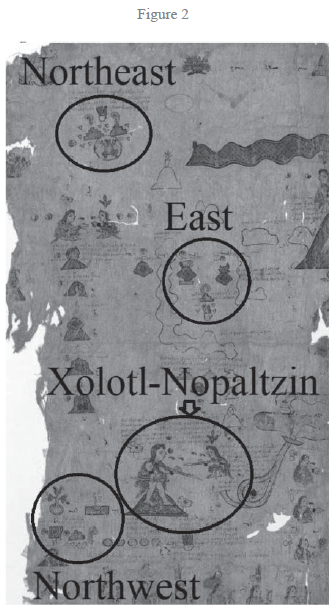
Douglas asserts that the aforementioned scene with Xolotl and Nopaltzin represents a conversation about exploring a country they have just entered (Figure 2, downward arrow). However, is his interpretation related to what Ixtlilxochitl proposes regarding Tollan? A possible answer is that Tollan is portrayed as a sizable portion of X.010, corresponding to an area delineated by a northeastern scene, an eastern scene, and a northwestern scene (Figure 2) that have several graphemes in common: the side profile of a mouth with a headdress, one or more eye-signs, one or two stepped pyramids, a group of three-to-eleven triangle-like drawings, and a curling appendage with hair. The side profile of a mouth with a headdress is the key because it stands for Toltecatl (Toltec), a singular noun, or Toltecah (Toltecs), its plural form.[20] This Toltecatl/Toltecah grapheme can be considered a phonogram since the headdress relies on tollin (cattail reed) to represent the syllable tol- and tentli (lips) for the syllable te- or tē-.[21] Thus, the Toltecatl/Toltecah grapheme in each of these scenes, which are situated close to Xolotl and Nopaltzin suggests a connection between the Toltecs and these Acolhua leaders.
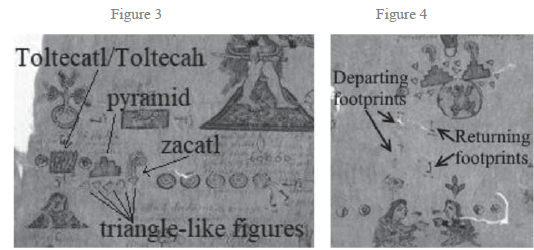
Given that the top of the Codex Xolotl represents east, one scene is northwest of the Standing-Xolotl-Sitting-Nopaltzin scene, another is northeast, and another is east of Xolotl and Nopaltzin (Figure 2). The northwest Toltecatl/Toltecah scene (Figure 3) lies behind the Standing-Xolotl-Sitting-Nopaltzin scene, and they are joined with footprint graphemes. This Toltecatl/Toltecah scene has a phonogram in which the headdress representing Tol is much larger than the mouth profile representing te, and this grapheme is surrounded by two circle-within-a-circle graphemes, one stepped-pyramid, five triangle-like drawings, and a hairy tail rising out of one of the triangles (Figure 3). Thouvenot (1987: 252-254) identifies the drawing of a circle-within-a-circle as ixtelolotli (eye), proposing that the 42 glyphs found in the Codex Xolotl represent two meanings: the syllable ix and the verb tlachia (see, observe). Furthermore, he theorizes that the ix/tlachia glyph represents tlachia when it can be considered an extension of a character as is the case in the northwest scene (Figure 4), connected to Xolotl through footprints, which Theuvenot defines as xocpalmachiyotl, giving ya (go) as one of the meanings.[22] As a result, probable meanings for the scene include yauh Xolotl… tlachia Xolotl…Toltecah (Xolotl goes…Xolotl observes…Toltec) or Toltecah… tlachia Xolotl (Toltec…Xolotl goes…Xolotl observes).
The northeast Toltecatl/Toltecah scene (Figure 4) and the east Toltecatl/Toltecah (Figure 5) scene also contain one or more tlachia (see or observe) graphemes. The top Toltecatl/Toltecah phonogram (Figure 4) is connected with footprints to a scene of a conversation between Xolotl and Nopaltzin in which both characters sit on the ground. Two footprints, though hard to see, begin above the xolotl grapheme that represents Xolotl, going to the Toltecatl/Toltecah scene containing one tlachia grapheme, two stepped-pyramids, two tail-like glyphs arising from the top of the stepped pyramids, and eleven triangle-like glyphs. Then, two footprints return to a point above and in between the xolotl glyph that denotes Xolotl and the nopalli glyph that denotes Nopaltzin. For this reason, yauh Xolotl…tlachia Xolotl…Toltecah (Xolotl goes…Xolotl observes…Toltec) or Toltecah… yauh Xolotl…tlachia Xolotl (Toltec…Xolotl observes…Xolotl goes) are probable interpretations of the northeast scene (Figure 4).
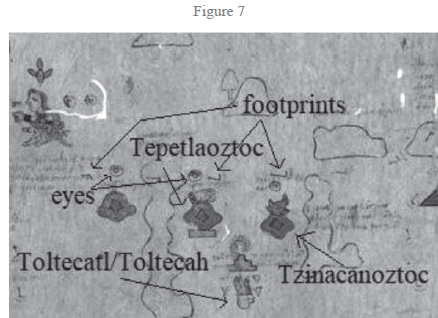
The eastern Toltecatl/Toltecah phonogram is more tenuously connected to the sitting Xolotl-Nopaltzin conversation (Figure 5). This Toltecatl/Toltecah phonogram in the eastern scene lies beneath a stepped pyramid with a hairy tail appendage and in between two oztotl (cave/ravine) graphemes. Each of these cave/ravine graphemes are beneath a tlachia grapheme and a footprint grapheme that are part of a series of footprint graphemes that begin below Nopaltzin and go right and pass above a series of three oztotl (cave/ravine) graphemes, which resemble a smaller rectangle within a larger rectangle. The alphabetic gloss identifies the caves above the Toltecatl/Toltecah phonogram as tepetlaoztoc (rocky-bed cave/ravine)[23] and tzinacanoztoc (bat-cave/ravine).[24] Oztoc is composed of oztotl and -c, the general Nahuatl locative so that Tepetlaoztoc, and Tzinacanoztoc can be translated as “through the rocky-bed cave/ravine” and “through the bat cave/ravine.”[25] As a result, yauh Nopaltzin…tlachia Nopaltzin…Toltecah (Nopaltzin observes… Toltec) or Toltecah… yauh Nopaltzin…tlachia Xolotl (Toltec… Nopaltzin observes) are probable in Figure 5 with two other elements, Tepetlaoztoc (through the rocky-bed cave/ravine) and Tzinacanoztoc (through the bat cave/ravine).
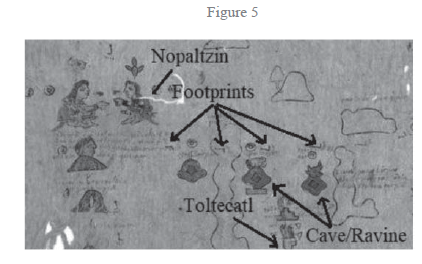
Ixtlilxochitl mentions in the Historia de la Nación Chichimeca that Xolotl came from the north to a ruined Tollan, which had been the capital of a Toltec Empire, thus the three Toltecatl/Toltecah glyphs in X.010 of the Codex Xolotl suggest that Ixtlilxochitl was influenced by this document. The northwestern scene (Figure 3) and northeastern scene (Figure 4) suggest that Xolotl observed areas connected in some degree to the Toltecatl/Toltecah glyph, whereas the eastern scene (Figure 5) refers to Nopaltzin observing a cave or ravine delineated by a Toltecatl/Toltecah glyph. One possibility for the decipherment of the three Toltecatl/Toltecah graphemes is that they reference a Toltec region that existed before the arrival of Xolotl and the Acolhua. After all, regions controlled by three altepemeh (city states) have been recorded in other Nahua works. Chimalpahin mentions an empire controlled by Colhuacan, Tollan, and Otompan; Chimalpahin and other Nahuas mention the alliance of Tenochtitlan, Tetzcoco, and Tacuba that formed the Aztec Empire; and Doñ Francisco Nayari, a Nahuatl-literate Cora, presents himself as the leader of a kingdom composed or led by the altepemeh of Guazamota, Ayotochpan, and Guaxicori.[26] Fortunately, as we will see in the following section, the other symbols — the hairy tail, the pyramid, and the triangular graphemes — suggest such an interpretation.
4. Exploring Ruins in the Codex Xolotl and Ixtlilxochitl’s Historia
The meaning of two-stepped pyramid glyphs, two tail-like glyphs, and the groups of triangle-like glyphs coincide with how Ixtlilxochitl wrote about a Toltec ruined landscape that needed to be explored. Ixtlilxochitl wrote, “[Xolotl] entered at the frontier and land of the Toltecs until arriving at the city of Tollan, capital of the empire, where he found large ruins depopulated and without people (Ixtlilxochitl, 1977: 14).” The three scenes with these three graphemes around one Toltec/Toltecah glyph identify the eastern part of the Basin of Mexico as Toltec territory in order to justify Acolhua control through the actions of Xolotl and Nopaltzin.
The Toltecatl/Toltecah glyph in the northwestern scene was somewhat different from the eastern and northeastern Toltecatl/Toltecah glyphs and some variations are also present in the other component glyphs. The northeast scene (Figure 6) contains two stepped-pyramids glyphs, two tail-like glyphs, eleven triangle-like glyphs, a tamazolin (toad) grapheme, a Toltecatl/Toltecah grapheme, and a tlachia (see, observe) grapheme.[27] Additionally, footprints connect this scene to that of the Sitting-Xolotl-Sitting-Nopaltzin-Conversation. The footprints—one with the toes close to the tlachia grapheme and one with the heel to the left of the toad within a circle grapheme— present Xolotl as the agent of the action in the journey. The footprints signify ya/yauh (go).[28] Together with the tlachia (observe) grapheme, the combination suggests yauh Xolotl…tlachia Xolotl…Toltecah (Xolotl observes… Toltec) or Toltecah… yauh Xolotl…tlachia Xolotl (Toltec…Xolotl observes). Since the first verb, ya/yauh, and the second verb, tlachia, are intransitive, the other symbols represent adverbial elements of time or place.
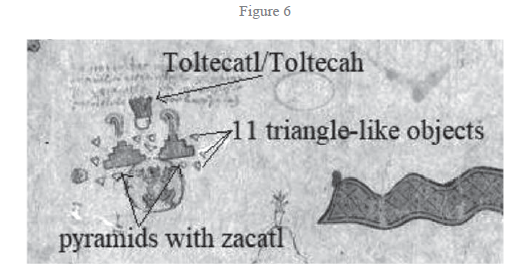
Both Dibble (1951: 162) and McGowan and Van Nice (1984: 67) identify the grapheme of the two stepped-pyramids with bushy appendages as a logogram for Teotihuacan, suggesting that one pyramid stands for its Pyramid of the Sun and the other for its Pyramid of the Moon (Figure 6). McGowen and Van Nice (1984: 67) also associate the symbol of a sun with Teotihuacan, whereas Thouvenot (1987: 177-178) laments that although the association of the sun grapheme with Teotihuacan has been established, the phonetic or logographic association remains inconclusive. Teotihuacan was an Acolhua-Nahua altepetl (community) during the time of the Aztec Empire (ca. 1428-1521) and during the early colonial period (1521-1608), which does not necessarily mean that an altepetl named Teotihuacan existed when Xolotl traveled there. The name of Teotihuacan itself is an homage to the previous settlement –Teo- (from teotl) means divine or true; ti- is a ligature; and -huan is an instrumental (with)– for a meaning of “place with the gods” or “place with truth.”[29] What can be more divine, truthful, or permanent than the ruins of the Pyramids of the Sun and the Moon? As result, it is proposed that the name of the site visited by Xolotl is not Teotihuacan, which is why it lacks the sun symbol associated with Teotihuacan in Xolotl 080.A.18 (Thouvenot, 177-178).
The two-pyramids do not represent a toponym, but the meaning of ruin is valid. The grapheme has two stepped tzacualli, “small hill, temple, or pyramid,” which is from the verb tzacua, “to close, enclose, lock up something or someone,” suggesting that a tzacualli grapheme represents an enclosed sacred space, perhaps within a small hill, a temple, or a pyramid.[30] Similar ruined pyramids are found in two Tetzcocan maps from the Relaciones Geográficas.[31] Meanwhile, the tail-like appendage that curls to the right is zacatl, a type of grass or weed, modifying the pyramid into a ruined site; a logogram with grass growing on ruined pyramids.[32] One glyph of zacatl thus aligns with the ruins of the Pyramid of the Moon and the other with those of the Pyramid of the Sun, suggesting that the placement of a tzacualli-zacatl grapheme represents pyramids with grass growing from their sides, referring to a ruined or depopulated area or city, and corresponding to the Nahuatl word poliuhqui, “thing [or things] that was lost,” which in turn comes from the verb polihui, “to perish, or to disappear and be destroyed” (Molina 2001: 83). Such an interpretation yields an adverbial phrase such as in ompa polihui Toltecah (there, where the Toltec perished).
The northeastern utterance, yauh Xolotl…tlachia Xolotl…Toltecah (Xolotl goes…Xolotl observes…Toltec) has two intransitive verbs – yauh and tlachia – so in ompa polihui Toltecah must be an adverbial phrase. The utterance can be:
yauh tlachiz Xolotl in ompa opoliuhque Toltecah [Pictographic Writing]
yauh tlachiz Xolotl in ompa opoliuhque Tolteca-h [Morpheme-by-Morpheme]
go see Xolotl where over. there plural. perished Toltec-plural [An English Gloss]
Xolotl goes to see over there where the Toltecs perished [English Translation].
The word in together with ompa subordinates in ompa opoliuhque Toltec (over there where the Toltecs perished) to the other clause, yauh tlachiz Xolotl (Xolotl goes to see).[33] Such a process yields the translation, “Xolotl goes to see over there where the Toltecs perished,” which is also supported by the eastern Toltecatl/Toltecah scene that contains one stepped-pyramid with a zacatl glyph rising from the top, yielding another polihui (perish) grapheme (Figure 4, Figure 6), and which should be read as:
yauh tlachiz Nopaltzin in ompa opoliuhque Toltecah,
Nopaltzin goes to see over there where the Toltecs perished [English Translation].
The eastern utterance is thus similar except that the agent and the site are different.
The eastern Toltecatl/Toltecah scene (Figure 7) presents the journey of Nopaltzin that began in the Sitting-Xolotl-Sitting-Nopaltzin scene. Nopaltzin traveled right, south, in the Codex Xolotl through three caves or ravines— Oztoticpac, Tepetlaoztoc, and Tzinacanoztoc—with the Toltecatl/Toltecah grapheme and the polihui grapheme being below Tepetlaoztoc (rocky-bed ravine place) and Tzinacanoztoc (batcave place). Nopaltzin went to see the Tepetlaoztoc and Tzinacanoztoc where Toltec ruins existed or where these two sites represented the boundaries of these ruins. In alphabetic Nahuatl such a story might be recorded as:
In ompa Tepetlaoztoc, yauh tlachiz Nopaltzin in ompa opoliuhque Toltecah
Nopaltzin goes to see over there where the Toltecs perished, over there in Tepetlaoztoc [English Translation].
This is the most likely possibility since Tepetlaoztoc became an important Acolhua site during the time of the Aztec Empire and into the early Colonial Period.
The northwestern Toltecatl/Toltecah scene (Figure 3) contains one stepped-pyramid and a zacatl glyph but, unlike the top and middle Toltecatl/Toltecah scenes (Figure 6 and Figure 7), the stepped-pyramid and the zacatl glyph are not together. Instead, the zacatl glyph rises from one of the triangle-like figures, suggesting that in the three Toltecatl/Toltecah scenes, the polihui grapheme has three elements: a pyramid glyph, triangle-like glyphs, and a zacatl glyph. Perhaps one Nahuatl writer (henceforth tlacuilo 1) created the northeast and east Toltecatl/Toltecah scenes in which a blade of grass (or zacatl) rises from the top of each of his stepped pyramids (Figure 6 and Figure 7). Tlacuilo 1 also drew the Toltecatl/Toltecah grapheme with lips (tentli) that are flush with the tollin (cattail reed) headdress. Another Nahua writer (henceforth tlacuilo 2) wrote the northwest Toltecatl/Toltecah scene, placing the zacatl glyph on top of one his five triangle-like objects (Figure 3) and writing a tollin headdress that was much bigger than the profile of lips (tentli). Therefore, these differences suggest two things. First, the polihui grapheme has three components –pyramid(s), zacatl, and triangle-like objects. Second, the polihui grapheme shows a lack of standardization, which was all too common in societies that lacked the printing press.
Thus, the polihui logogram has the same three components in the three Toltecatl/Toltecah scenes, but polihui in each scene has a different quantity of pyramids and triangle-like objects. Such differences probably suggest that the depicted sites varied in size. The northeast scene (Figure 6) consists of two pyramids, each with a zacatl glyph, and eleven triangular shards. It also has a tamazolin (toad) glyph within a circle. The eastern scene (Figure 8) only has one pyramid with a zacatl glyph and three triangular shards. The northwestern scene (Figure 9) has five triangle-like shards, one pyramid, and one zacatl glyph. The northeastern site is the biggest one, then the northwestern site, and the eastern site is the smallest one.
The meaning of the three utterances coincides with how Ixtlilxochitl saw this portion of the Codex Xolotl, writing about a Toltec ruined landscape that needed to be explored. Ixtlilxochitl writes, “[Xolotl] entered at the frontier and land of the Toltecs until arriving at the city of Tollan, capital of the empire, where he found large ruins depopulated and without people.” Ixtlilxochitl presents the land of the Toltecs represented by the three Toltecatl/Toltecah scenes, but he also writes about the altepetl of Tollan, suggesting that Xolotl did not settle there, but “continued with his people, always sending explorers.” Thus, Ixtlilxochitl makes a distinction between Tollan and the land of the Toltecs even as he classifi es both as being depopulated, but is the distinction between the capital and its surrounding domain important?
5. Evidence for Tollan
Ixtilxochitl in his Historia de la Nación Chichimeca coincides to some degree with the meaning in the three Toltecatl/Toltecah scenes. However, he distinguishes between the land of the Toltecs and their cabecera (capital) of Tollan, a distinction that is not apparent in X.010 of the Codex Xolotl. I propose that the tamazolin glyph serves as the key by being a second phonogramfor Tollan, the capital of the Toltec realm.
The northeast Toltecatl/Toltecah scene (Figures 5 and 7) represents the largest Toltec site given that it has two pyramids and eleven triangular shards. However, it is unlikely that the Toltecatl/Toltecah grapheme represents Tolteca and Tollan at the same time given the presence of a glyph of a toad within a circle, which Thouvenot (1987: 84-86) identifies as tamazolin (toad), classifying it as a toponym for Tamazolac. He does so since a site with the name of Tamazolac is connected to the Toltecs in Anales de Cuauhtitlan (apud Bierhorst 1992: 16-17).[34] In other contexts, Theuvenot (tamazolin, online) suggests that the tamazolin grapheme represents the sound azca (ant) when used in conjunction with an ant-hill grapheme to denote Azcapotzalco (place of the anthill), an important city-state. A re-examination of the tamazolin grapheme in the Codex Xolotl is warranted given the new readings of the three Toltecatl/Toltecah scenes.
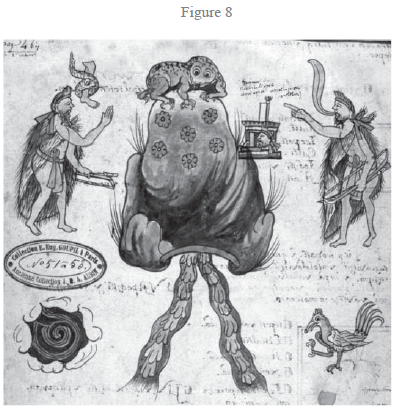
Tamazolin is generally drawn from a bird’s eye view of the body and a right-side view of the head (Figure 8). Additionally, tamazolin is within a circular construct in at least five instances in the Codex Xolotl, which Theuvenot (1987: 84-87) classifies as being in the first folio at X.010.B.03+05; the sixth one at X.060.F.56; and the eighth one at X.080.C.08, X.080.D.16 and at X.080.F.22.[35] The first appearance of tamazolin is in X.010, in the middle Toltecalt/Toltecah scene (Figure 6) in which the toad is in the middle of a blue-filled circle, which probably represents water. Later tamazolin appears in subsequent folios within ant-hill graphemes representing Azcapotzalco. Tamazolin is thus first connected to the Toltecs and later to Azcapotzalco, an altepetl in the Basin of Mexico, built after the arrival of Xolotl and before the Aztec Empire.
The association of the Toltecs with Azcapotzalco suggests that the toad within the blue circle should be read as tolontic, which meant round or spherical in Central Nahuatl.[36] The toad, a round or spherical animal, was a way for the authors of the Codex Xolotl and other works to represent tolontic, something spherical, a three-dimensional concept, on a two-dimensional space. As such, tolontic is a rebus grapheme that should be read as /to lon/, a near homonym for Tollan /to:l la:n/. With tolontic being a grapheme for Tollan, its presence with the azcapotzalli grapheme makes sense as the representation of not just Azcapotzalco, but Tollan-Azcapotzalco, a powerful altepetl constructed by people who were seen as a civilizing force in the Basin of Mexico.
Azcapotzalco was the center of power for the Tepaneca-Nahua so it deserves the appellation of Tollan-Azcapotzalco since Ixtlilxochitl also writes that Xolotl gave Azcapotzalco to Acolhua, the leader of the Tepaneca-Nahua, to serve as “the capital of his kingdom.”[37] As such, Tollan-Azcapotzalco stands for the new socio-political center of the Tepaneca-Nahua group at a time when they were transitioning from chichimecayotl (nomadism) to toltecayotl, “civilized” sedentary living.[38] Such evidence suggest that tamazolin represents a second Tollan grapheme (henceforth Tollan2), which served to identify this city-state alongside Tollan1, which was based on the Nahuatl word tolin (sedge grass, reeds).[39] A Tollan2 grapheme leads to a better translation of the northeast Toltecatl/Toltecah scene (Figure 6):
in ompa Tollan, yauh tlachiz Xolotl in ompa opoliuhque Toltecah [Morpheme-by-morpheme]
Over there in Tollan, Xolotl goes to see over there where the Toltecs perished [English translation].
Such a sentence mirrors Ixtlilxochitl’s passage about Xolotl entering “the frontier and land of the Toltecs until arriving at the city of Tollan, capital of the empire, where he found large ruins, depopulated and without people.”[40]
One counter-argument to Tollan2 is that investigators record different words that mean round or spherical. Molina (2001: 76, 91, 148) also records tapayoltic to mean spherical or round, whereas Harold Key and Mary Ritchie de Key (apud Frances Karttunen 1992: 178) record that ololtic also means round or spherical in the dialect of Nahuatl from the Sierra de Zacapoaxtla in Puebla. Did Molina make an error or do these words represent different dialects of Nahuatl? Molina recorded tolontic in both the Spanish/Nahuatl and Nahuatl/Spanish word lists, and he also wrote that he had trouble with the words, lamenting that some were used in some provinces and not in others, suggesting that he was selective in what he recorded due to the many variants of Nahuatl that he experienced.[41] Furthermore, Una Canger and Karen Dakin (1985:359) suggest that Molina recorded words from at least two variants, basing their assertion on his inclusion of two words with the same meaning as in sentli/sintli (dried corn ear), istetl/istitl (nail), ihtetl ihtitl (stomach), tesi/tisi (to grind), and textli/tixtli (corn dough). Therefore, tolontic, tapayolli, and ololtic probably represent examples from different dialects of Nahuatl leading to the possibility that the writers of the Codex Xolotl either employed tolontic in their variant of Nahuatl, developing the tolontic phonogram, or they adopted the tolontic phonogram along with the writing conventions of another Nahua people.
Either possibility is plausible for Tollan2 given the evidence for different graphemes to represent city-states connected to Tollan. Tolin is used in the Tollan1 grapheme and in combination with tentli to represent Toltec. Nahuas from Tenochtitlan-Tlatelolco exclusively relied on Tollan1 as in a drawing of five pieces of sedge grass with roots in the Codex Aubin; five pieces of sedge grass with pips arising from a hill-temple in the Codex Azcatitlan; and six pieces of sedge grass within a circle that contains a fish in the Codex Boturini (Boone 2000: 210-213). Meanwhile, writers from nearby Cuauhtinchan connect Chollula to Tollan in the codex known as Historia Tolteca-Chichimeca (Figure 8), drawing a frog atop a hill enclosing seven flowers, which is “the first pictorial representation of Chollula in the annals, and two themes are underscored: the multitude of appellations—and thus identifying aspects—of the site, and the locale’s link to the Tolteca heroes” (Leibsohn 2009: 109).[42]
A frog atop a hill enclosing six (Figure 8) or seven flowers (not shown) may represent instances of a Tollan2 grapheme associated with the city-state of Cholula.[43] The flowers are presented from a birds-eye view with reddish circular petals around a circular center.[44] The only birds-eye view flower in the Codex Xolotl is poyomatli, which resembles a rose, but is most definitely not portrayed as circular.[45] As a result, the flowers are probably borrowings from European conventions as presented in works like the Breviary of Queen Isabella of Castille, which has several flowers depicted from a bird’s eye view and which was used by the Dominicans.[46] A reading of the six or seven flowers as poyomatli with frog (cueyatl, cuiyatl, or acacuiyatl in Nahuatl) does not lead to any words related to Cholula, but a reading of the six or seven flowers as xochitl (flower) together with the frog offers two possibilities. First, Tollan2, /tolon/, can be paired with xo- /ʃo/, the first syllable of xochitl (flower), for a phonetic representation of the less Hispanicized form of Cholula, Chollulan, as /tʃo:l on/.[47] In other words, the “ʃo” sound of xochitl is combined with the “tolon” of Tollan2 to represent “chōlon” for Chollulan, with “ula” not being represented phonetically.[48] Second, the frog plus the flowers may refer to xochcatl, a small green frog that lives among the weeds, to represent the phonetic sound xochca which is affiliated to Cholula in some other way.[49]
6. Toltecah/Toltecatl, Polihui, Tollan2, and Ixtlilxochitl’s Work
In Historia de la Nación Chichimeca, Ixtlilxochitl defined the Toltecs as master engineers in Chapter 3, which mirrors how Molina defined toltecayotl (Toltecness), representing Nahua views that the Toltecs were advanced and that Tollan represented civilization. Such a view is proposed in this work which theorizes polihui and Tollan2 graphemes that serve to describe how Xolotl and/or Nopaltzin explored and observed the remains of Toltecness. Ixtlilxochitl’s work and X.010 of the Codex Xolotl coincide in placing the Toltec realm in a northern region. The former by explaining that Xolotl arrived from the north to the Toltec realm and the latter by placing the Toltecatl/Toltecah graphemes on the left, which corresponds to the northern portion of the Basin of Mexico.
The decipherment of the Toltecatl/Toltecah grapheme has been well-accepted and for this reason, three Toltecatl/Toltecah scenes were chosen for analysis. These three Toltecatl/Toltecah scenes are northwest, northeast, and east of the Standing-Xolotl-Sitting-Nopaltzin scene. The northeast Toltecatl/Toltecah scene depicts the largest site since it contains eleven triangular shards, two pyramids, and two zacatl glyphs. The northwest Toltecatl/Toltecah scene depicts the next largest site since it has five triangular shards, one pyramid, and one blade of grass (zacatl in Nahuatl). The eastern Toltecatl/Toltecah scene is the smallest with three triangular shards, one pyramid, and one blade of grass. The common occurrence of the blade(s) of grass (zacatl), the pyramid(s), and the triangular shards together with the Toltecatl/Toltecah grapheme suggests a polihui grapheme defined as “to perish, or to disappear and be destroyed.” Such a polihui morpheme together with the northern location of the Toltecatl/Toltecah scenes supports the words of Ixtlilxochitl (1977: 14) in that:
the aforementioned [Xolotl] left from the north, from the region and province that is known as Chicomoztoc [The Place of the Seven Caves], and having entered at the frontier and land of the Toltecs until arriving at the city of Tollan, capital of the empire, where he found large ruins, depopulated and without people, for which reason he did not want to settle in Tula.
Xolotl entered from the north in Ixtlilxochitl’s work and went “in ompa polihui Toltecah” (over there where the Toltec perished) in X.010 of the Codex Xolotl. I agree with other scholars that more than one tlacuilo worked on X.010 of the Codex Xolotl. I propose that tlacuilo 1 worked on the northeastern and eastern Toltecatl/Toltecah scenes given that both have the blade of grass (zacatl) rising from the stepped pyramids, and a tollin headdress that fits the tentli headdress snugly. I propose that Tlacuilo 2 worked on the northwestern scene, which contains a blade of grass (zacatl) rising from a shard and a Toltecatl/Toltecah grapheme that has a headdress that is much bigger than the tentli profile.
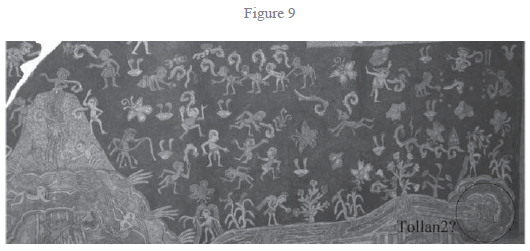
Finally, I proposed that a Tollan2 grapheme consisting of a frog/toad within a circle presents the phonetic value of tolon from tolontic, something circular or spherical. When a frog or toad inflates his air-sac, he transforms himself into a spherical object that Nahuas, master observers of their natural world, noticed and depicted in the Tollan2 grapheme. Tlacuilo 1 used such a grapheme to depict Tollan in X.010, which lies close to the site now known as Teotihuacan, and which was drawn with two ruined pyramids. Ironically, one of the apartment compounds of Teotihuacan, which is known as Tepantilta contains a mural depicting a large number of people enjoying themselves in a site with a mountain flowing with water. On the right side of this mural, sits an amphibian-like animal observing the festivities and secreting the water (Figure 9). Does this amphibian represent Tollan2?
Acknowledgements
Different people have influenced this work, but any mistakes are mine. I thank Karl Taube for suggesting that I study the Codex Xolotl in his class. I am grateful to Dr. Claudia Parodi-Lewin who read a copy of an earlier draft and encouraged me to publish it. After a second rejection, I consulted Kevin Terraciano, my advisor and mentor at UCLA, and I thank him for suggesting that I consult Jerome Offner and Benjamin Johnson, who offered helpful advice over a series of emails. Gordon Whittaker also aided me, sharing his views about Nahuatl logosyllabic writing in the Codex Xolotl and the Lienzo de Tlaxcala. I thank Karen Dakin for providing me a Spanish copy of Marc Thouvenot’s dissertation and for her help with Nahuatl. Finally, I want to thank Rosa Yáñez Rosales for encouraging me to participate in the Taller de Amigos Lenguas Yutoaztecas.
Footnotes
[1] Mundy 2000, Boone 2000, Douglas 2010.
[2] Figure 1 is a photo of the first folio of the Codex Xolotl. Figure 1 and all subsequent figures of the Codex Xolotl are from a photo: courtesy and Copyright Bibliothèque Nationale de France. Other figures have attached fonts, which were accomplished through the use of paint.net, a free image and photo editing software for computers that run Windows.
[3] Lyle Campbell (2013: 387) refers to Maya and Egyptian hieroglyphics as mixed scripts, adding that these are also known as logosyllabic scripts. Alfonso Lacadena (2008a: 1, 21) presents Nahuatl writing as logosyllabic, emphasizing that writers from the Tetzcoco school tended to be more phonetic than those of the Tenochtitlan school and that symbols could have logographic and syllabic meanings as in huehue, which could stand for drum or the syllable we /we/. Gordon Whittaker (2009: 48) refers to Nahuatl writing as logosyllabic and laments that the attention that has been devoted to Nahuatl writing has focused on its connection to iconography and not to its linguistic purpose.
[4] Bourdieu (1993: 215) writes, “An act of deciphering unrecognized as such, immediate and adequate ‘comprehension’, is possible and effective only in the special case in which the cultural code which makes the act of deciphering possible is immediately and completely mastered by the observer (in the form of cultivated ability or inclination) and merges with the cultural code which has rendered the work perceived possible.
[5] Florian Coulmas (1989: 9, 13) mentions that writing is a “collectively created tool, a means of production whose invention answered certain needs and made possible a whole range of novel activities and modes of production, as well as kinds of societal communication and economic exchange.” In a society with writing, a literate community learns, manipulates, and perpetuates a writing system as a cultural code, utilizing graphemes in prescribed and, sometimes, unique ways to represent spoken utterances that can be decoded by participants. A literate community conversant with Nahuatl, and perhaps other languages, fashioned the Codex Xolotl, but this group diminished during and after the fall of the Aztec Empire due to epidemic diseases, war, and subjugation. Then, from Mexico City and other cities, Europeans forced, encouraged, and cajoled both Nahuas and non-Nahuas to tie Nahuatl to the Roman alphabet, beginning a new literate community that connected a Mesoamerican language to an imported writing system. Thus, the Nahuatl language, preserved in alphabetic works from the sixteenth and seventeenth centuries, represents an important connection to the literate community that created and/or utilized symbols in the Codex Xolotl.
[6] Thouvenot (1987: 84-86) classifi es the fi rst folio as X.010, the second as X.020, the third as X.030, etc.
[7] I use “Central Nahuatl” to represent the Nahuatl that is preserved in alphabetic documents because this term is widely recognized by a large audience. In Beyond the Codices: The Nahua View of Colonial Mexico, Arthur J. O. Anderson, Frances Berdan, and James Lockhart divided Nahuatl documents into two sub-types, Classical and Peripheral variants, with the former containing the polished Nahuatl of the high nobility of large towns within or close to the Basin of Mexico, and the latter encompassing petitions by the nobility of small towns whose Nahuatl is less formal. Then, Una Canger proposed a different solution in her paper “Nahuatl Dialectology.” She consulted colonial and present-day Nahuatl variants and suggested a division of Nahuatl into Central and Peripheral variants that encompassed present and past varieties of this language. Afterwards, Lockhart and other scholars adopted “Central” to replace “Classical,” accepting the peripheral and central division to classify variants of Nahuatl preserved in documents from the sixteenth to the nineteenth centuries.
[8] James Lockhart (1992: 262-263, 264, 556) proposes the categorization of alphabetic documents into four stages that reflected the degree of acculturation by the Nahua authors, identifying the census records of the Cuernavaca region written between 1535 and 1545 as the only known alphabetic corpus of Stage 1 Nahuatl.
[9] Lockhart (1992: 289) adds, “a hundred-year period of borrowing virtually only nouns began with a flood of basic loans in the second postconquest generation.” Lockhart (1992: 304) writes, “Stage 3 took shape far more gradually than Stage 2, with more hints of regional variation in timing. Some advance signs can be detected as early as the final decade of the sixteenth century; then the momentum increases after about 1620 or 1630, and by around 1650 one can speak of a fully formed Stage 3 Nahuatl.”
[10] “Ouest” is found in a photograph by Dibble (1951: Plancha 1) of X.010, but not in more recent photographs.
[11] I have to thank a previous anonymous reviewer for pointing out the usage of tiopan/teopan and teocalli. Molina (2001: 101) whom Lockhart (1992: 284) classifi es as a purveyor of Stage 2 Nahuatl employs teopan exclusively.
[12] Florian Coulmas (1989: 30) relies on Ferdinand de Saussure’s proposal that a linguistic sign contains a signifi er and that which is signified, proposing that a writing community phoneticizes logogramic graphemes in three steps. First, the written sign conveys both an idea (the signified) and a sound picture (the signifier). It is not language-specific, but it may rely on certain cultural conventions used by one or more speech-communities that can interfere with decoding the meaning. The next step is the creation of rebus signs, each of which has one sound image, but two ideas because homophony allows a grapheme to portray hard to record utterances such as proper names. Coulmas, The Writing Systems of the World, 30. Lacadena, “Regional Scribal Traditions: Methodological Implications for the Decipherment of Nahuatl Writing,” 7. Whittaker, The Principles of Nahuatl Writing, 56. For example, English speakers can text, “I’m l8” or “I’m late.” In the first instance, they use “8” as a rebus phonogram for its sound value of /eyt/ not as a logogram for the number.
[13] I do not use the term “word list” to denigrate the work of Alonso de Molina, but as a more neutral term than dictionary, which carries certain cultural implications that I want to avoid. A team led by Julia Madajczak is leading the investigation into a newly discovered set of census records, which were found in Kraków, Poland. Szymon Zdiebłowski, “Unique document about the Aztecs studied in Poland” in Science in Poland (Accessed on August 23, 2018): Online at:
[14] Robertson (1959: 159) asserts that the Codex Xolotl was drawn as seen from the mountains in the west and it is recognizable even today as representing the Basin of Mexico with east at the top (Dibble 1951: 17, Boone 2000: 79, Douglas 2010: 46, Robertson 1959: 141).
[15] Molina (2001: 148) wrote, “maestria de arte mecánica.”
[16] Ixtlilxochitl (1977: 14) wrote: “el cual salió de hacia la parte septentrional y de la región y provincia que llaman Chicomoztoc, y habiendo entrado por los términos y tierra de los tultecas hasta llegar a la ciudad de Tolan, cabecera del imperio, en donde halló muy grandes ruinas despobladas y sin gente, por lo que no quiso hacer asiento en Tula, sino que prosiguió con sus gentes enviando siempre exploradores...”.
[17] Donald Robertson (1959: 159) asserts that the Codex Xolotl was drawn as seen from the mountains in the west. Refer also to Charles E. Dibble, Códice Xólotl, 17. Marc Thouvenot, “Códice Xólotl. Estudio de uno de los componentes de su escritura; Los glifos. Diccionario de los elementos constitutivos de los glifos,” 123. Elizabeth Hill Boone, 79. Eduardo de J. Douglas, 46.
[18] The alphabetic gloss (Dible 1951: Plancha 1) identifies the sitting figure on the left as Xolotl, which is the name of a canine god, whereas the logosyllabic grapheme represents a two-dimensional animal with a trapezoidal ear. Mary Miller and Karl Taube (1993: 190) propose that Xolotl, the deity, is the faithful assistant and companion to Quetzalcoatl and add that Xolotl was also identifi ed with sickness and physical deformity, often being portrayed in codices with a ragged-edged ear. Theuvenot (1987: 408-410) presents a more detailed explanation of meanings connected to xolotl and xoloitzcuintli in the Codex Xolotl.
[19] Karttunen (1992: 173) defi nes nohpalli as the prickly pear cactus and proposes that Nahuas employed two main varieties: opuntia vulgaris and opuntia cochinillifera. The first was more familiar and prized for its fruit, which Molina (2001: 72) recorded as nochtli and translated as tuna. Molina (2001: 73) defined nopalli as ramas de tuna, which is a probable reference to the branches of opuntia vulgaris.
[20] Dibble (1951: 18) proposes a grapheme composed of two phonograms: a headdress topped with “sedge grass or reeds” (tōllin) for /tol/ and a head with a line denoting a “mouth” (tentli) for /te/, which yield /tol te/catl (singular) or /tol te/cah (plural). Theuvenot (1987: 608) posits that a mouth (or tēntli) phonogram denotes /te:/ with a long vowel, whereas a rock (tetl) phonogram denotes /te/ with a short vowel. Douglas (2010: 47) comes to the conclusion that the grapheme is composed of tōllin at the top but that the bottom symbol of a human head in profile view is a logogram standing for tecatl, inhabitant, and thus /toltecatl/ or /tolteca/h. The main differences are that Dibble would not account for plurality and his logogram is composed of two syllabic elements, whereas Douglas proposes a grapheme portraying the singular form, Toltecatl. Lacadena and Wichman (apud Lacadena 2008b: 23) support Dibble’s construction of /te/.
[21] The Toltecatl/Toltecah phonogram is also found fourth time beneath hill-standing Xolotl, but its meaning is more uncertain because it is not accompanied by the aforementioned graphemes.
[22] Thouvenot (1987: 316-18) describes footprints in the Codex Xolotl as being present in a variety of pliable surfaces, defining them as xocpalmachiyotl (foot-sign) and proposing that they appear in 48 glyphs.
[23] Tepetlaoztoc has three components—tetl (rock), oztotl (cave), and petlatl (mat)—which are used as logograms to record /tepetlaozto/. Molina (2001: 81) defines petlatl as, “estera generalmente,” which Karttunen (1992: 192) translates as, “woven mat, petate.” As Lacadena (2008b: 23) and Whittaker (2009) propose, /te/ can function as a syllable and be a phonogram, but in this instance, it appears to function as a logogram to depict a rocky-bed cave or ravine.
[24] Tzinacanoztoc, is composed of the cave/ravine logogram and a logogram of a mammal with two triangular ears and an open maw, probably referring to tzinacan, “bat that bites.” Molina (2001: 152) identifi es tzinacan as “murcielago que muerde,” and Karttunen (1992: 312) presents two variants: tzinacantli and tzonācatl.
[25] Dibble (1951: Plancha 1) presents the alphabetic gloss of three terms: oztoticpac, tepetlaoztoc, and tzinacanoztoc — which have the term -oztoc from oztotl (cave) and -c which Launey (2011: 116-117) refers to as the general locative suffix in Central Nahuatl. Furthermore, Molina (2001: 78) translates oztotl as cueva (cave) or caverna (cavern or ravine). According to the dictionary of the Real Academia Española (consulted on August 30, 2019), caverna can refer to a deep cavity that is between rocks or underground. Other variants of Nahuatl likewise employ oztotl as cave or ravine. John García (personal conversation on October 2017) defines oztotl as cave or cavity in Huasteca-Veracruz Nahuatl; Lyle Campbell (1985: 555) writes that in Pipil-Nahuatl, ustu:t means “ravine, cave”; and the Dictionary of Nahuatl of the Wired Humanities Project at the University of Oregon (consulted on October 1, 2017) defines oztotl as, “a cave, a cavity, also a metaphor for the womb.” Launey (2011: 116) defines -c as the only Nahuatl locative. Diccionario de la Real Academia Española, s.v. “caverna,” online at: https://dle.rae.es/?id=81WyCW7 (accessed on August 30, 2019).
[26] Chimalpahin (2003: 74-75) writes about a teuctlahtollo, which Rafael Tena translates as señorio (kingdom, empire), led by leaders from Colhuacan, Tollan, and Otompan. For the relationship between the three dominant cities of the Aztec Empire, refer to The Tenochca Empire of Ancient Mexico: The Triple Alliance of Tenochtitlan, Tétzcoco, and Tlacopan by Pedro Carrasco and Aztec Warfare by Ross Hassig. Don Francisco Nayari (apud Garcia 2016: 3-4, 366) mentions these three communities of Northwestern New Spain in a letter to Bishop Juan Ruiz Colmenero dated to 1649.
[27] The symbol may represent a frog, but I am following Thouvenot’s (1987: 84-86) classification of it as tamazolin (toad).
[28] Thouvenot (1987: 317-319) examines the footprint symbol as a phonogram for personal names, connecting it with the Nahuatl verbs ya/yauh (go), paina (run), temo (to descend), totoca (run), and ohtli (road). Molina (2001: 68) provides the definitions for ya/yauh and nehnemi.
[29] Molina (2001: 101). Francisco Javier Clavijero (1974: 134), and Horacio Carochi (2001: 204-205) define teotl as god. However, it is also possible that teotl means truth since native Nahuatl-speakers from the Basin of Mexico such as José Concepción Flores Arce Xochime (2005: 9) defines teomexicah as “true Mexicans,” and Don Anton Muñon Chimalpahin (1998: 183) employs Teocolhuacan as a toponym for an altepetl in western Mexico, which suggests the meaning of “true” Colhuacan. Luis Cabrera (1995: 130) defines Teotihuacan as lugar de los dioses (place of the gods), entre los dioses (among the gods), or donde hay dioses alrededor (where gods are around).
[30] Karttunen (1992: 310) provides the definition of tzacualli. Theuvenot (1987: 670-672) analyzes the connection between the logogram and the word, explaining that the number of platforms vary and proposing that it also represents teopan, temple.
[31] Robertson (1959: 142-143) proposes that a similar glyph of ruined pyramids are in two maps from the Relación Geográfica of Tetzcoco, being characterized by a series of steps diminishing in size toward the top of the pyramid, which lacks a building on top.
[32] McGowan and Van Nice, 105-107. Thouvenot (1987: 483, 767) gives a grapheme that resembles a curled tail with hair the phonetic value of zacatl. Also in Theuvenot, Códice Xolotl online (Consulted on December 8, 2018), Online: http://thouvenotmarc.com/textos/codice_xolotl.html.
[33] Lockhart (2001: 58) refers to in as the general subordinator of Central Nahuatl, whereas (Launey 45, 333) defines it as a relative pronoun, which can refer to “where” when paired with adverbs like nican (here), oncan (there), and ompa (over there).
[34] I learned of Tamazolac from several email conversations about the Codex Xolotl with Jerome Offner and Benjamin Johnson.
[35] Thouvenot numbers the folios in the following manner: X.010 represents a space in the first folio, X.020 represents a space in the second folio, X.030 in the third, etc.
[36] Molina (2001: 102, 148) defines tolontic as “redondo spherico como bola o botija” or “cosa redonda como bola.”
[37] Ixtlilxochitl (1977: 17) writes that Xolotl gave Acolhua, lord of the Tepanec, his daughter Cuetlaxxochitzin, as his wife and the city of Azcapotzalco as “cabeza de su señorio.”
[38] Ixtlilxochitl (1977: 13) writes, “Estos tultecas eran grandes artífices de todas las artes mecánicas: edifi caron muy grandes e insignes ciudades, como fueron Tolan, Teotihuacan, Chololan...” thereby providing the definition of toltecayotl, but I subsequently argue that he was guilty of presentism in presenting Teotihuacan and Tula as existing in the same period. I will also discuss Chololan (Cholula), but in a different context.
[39] Molina (2001: 148) defines tollin as “juncia o espadaña,” which Karttunen (1992: 92) translates as “sedge grass.”
[40] Ixtlilxochitl, Historia de la nación Chichimeca, 14.
[41] Molina (2001: Prologo) writes: “Lo segundo averseme puesto delante la variedad y diversidad que hay entre los vocablos, porque algunos se usan en unas provincias, que no los tienen en otras y esta diferencia, solo que oviesse bivido en todas ellas la podria dar a entender.”
[42] The artist who drew the map of the Relación Geográfica of Cholula wrote TOLLAN CHOLULĀ in which the bar over the “A” stands for “AN”. Mundy, 51.
[43] Figure 8 is an image from the Historia Tolteca-Chichimeca, which was made available by the Bibliothèque Nationale de France, which holds the copyright.
[44] These flowers in the Historia Tolteca-Chichimeca do not resemble the xochitl grapheme in the Codex Xolotl, which are represented from a side-view with the stamen and usually three petals, standing for the phonetic values of xochitl or xochi (Thouvenot 1987: 501). They also do not resemble the flower held by the child in the Juchipila grapheme of the Lienzo de Tlaxcala.
[45] Thouvenot, codex Xolotl, online at http://thouvenotmarc.com/textos/codice_xolotl.html
[46] British Library, Digitized Manuscripts (Consulted on December 8, 2018). Online:
http://www.bl.uk/manuscripts/FullDisplay.aspx?ref=Add_MS_18851
[47] In the International Phonetic Alphabet (IPA), the grapheme “ʃ” represents the “sh” sound in words like “sheep” and “sheet”, which would be transcribed as /ʃip/ and /ʃit/ in IPA, whereas “tʃ” represents the “ch” sound in words like “cheap” and “cheat,” which would be transcribed as /tʃip/ and /tʃit/. Peter Latefoged, A Course in Phonetics, 57.
[48] Here, I used the well-accepted “ō” to represent this long vowel in Nahuatl instead of “o:” which represents this same vowel in the IPA system.
[49] Molina (2001: 160) writes: “ranilla verde que se cria entre las yerbas.”
References
Anderson, Arthur J. O., Frances Berdan, and James Lockhart (1976). Beyond the Codices: The Nahua View of Colonial Mexico. Berkeley/Los Angeles, University of California Press.
Andrews, J. Richard (2003). Introduction to Classical Nahuatl revised edition. Norman, OK: University of Oklahoma Press.
Bierhorst, John (1992). Codex Chimalpopoca: The Text in Nahuatl with a Glossary and Grammatical Notes. Tucson and London: The University of Arizona Press.
Boone, Elizabeth Hill (2000). Stories of Red and Black: Pictorial Histories of the Aztecs and Mixtecs. Austin, TX: University of Texas Press.
Borland, Kathryn (2006). “‘That’s not what I said’: Interpretative Conflict in Oral Narrative Research.” In The Oral History Reader 2nd Edition, edited by Robert Perks and Alistair Thompson, 310-321. London and New York: Routledge.
Bourdieu, Pierre (1993). “Outline of a Sociological Theory of Art Perception.” In The Field of Cultural Production: Essays on Art and Literature, edited and introduced by Randal Johnson, 215-237. Cambridge: Polity Press.
Cabrera, Luis (1995). Diccionario de aztequismos. México, D. F.: Secretaría de la Defensa Nacional.
Campbell, Lyle 1985. The Pipil Language of El Salvador. Berlin, New York, Amsterdam: Mouton Publishers.
—— (2013). Historical Linguistics: An Introduction, 3rd Edition. Cambridge, MA: The MIT Press.
Canger, Una and Karen Dakin (1985). “An Inconspicuous Basic Split in Nahuatl” International Journal of American Linguistics, Volume 51, Number 4 (Oct., 1985), 358-361.
Canger, Una (1988). “Nahuatl dialectology: A survey and some suggestions”. En International Journal of American Linguistics, 54(1), pp. 28-72.
Carochi, Horacio (2001). Grammar of the Mexican language: with an explanation of its adverbs (1645). Translated and edited with commentary by James Lockhart. Stanford, CA: Stanford University Press and UCLA Latin American Center Publications.
Carrasco, Pedro (1999). The Tenochca Empire of Ancient Mexico: The Triple Alliance of Tenochtitlan, Tetzcoco, and Tlacopan. Oklahoma: University of Oklahoma Press.
Chimalpahin, Domingo (2003). Las ocho relaciones y el memorial de Colhuacan I. Transcribed and Translated by Rafael Tena. México D.F.: CONACULTA, Consejo Nacional para la Cultura y las Artes.
Clavijero, Francisco Javier (1974). Reglas de la lengua mexicana con un vocabulario. Mexico City: Instituto de Investigaciones Históricas /UNAM.
Coulmas, Florian (1989). The Writing Systems of the World. Oxford: B. Blackwell.
Dibble, Charles E. (1951). Códice Xolotl. Mexico City: University of Utah and Universidad Autónoma de México, Instituto de Investigaciones Históricas.
Douglas, Eduardo de J. (2010). In the Palace of Nezahualcoyotl: Painting Manuscripts, Writing the Pre-Hispanic Past in Early Colonial Period Tetzcoco, Mexico. Austin: University of Texas Press.
Flores Arce Xochime, José Concepción (2005). Quetzaltlahtolli: Palabra náhuatl contemporánea. Illustrated by José Zuñiga Delgado and with graphic designs by Flor Soledad Hernández Villegas. Mexico City: José Concepción Flores Arce Xochime, Jesús Villanueva Hernández, and Juan Carlos Loza Jurado.
García, Ricardo Medina (2016). “Nahuatl-Language Petitions and Letters from Northwestern New Spain, 1580-1694.” Doctoral Thesis, University of California, Los Angeles.
Gerhard, Peter (1993). A Guide to the Historical Geography of New Spain. Revised edition. Norman and London: University of Oklahoma Press.
Gibson, Charles (1964). The Aztecs under Spanish Rule: A History of the Indians of the Valley of Mexico, 1519-1810. Stanford: Stanford University Press.
Gruzinski, Serge (1993). The Conquest of Mexico: The Incorporation of Indian Societies into the Western World, 16th—18th Centuries. Translated by Eileen Corrigan. Cambridge: Polity Press.
Ixtlilxochitl, Fernando de Alva (1977). Obras históricas. Incluyen el texto completo de las llamadas Relaciones e historia de la nación chichimeca en una nueva versión establecida con el cotejo de los manuscritos más antiguos que se conocen. Tomo II. Edited with an introductory study, and a documentary appendix by Edmundo O’Gorman. Mexico City: Universidad Nacional Autonóma de México, Instituto de Investigaciones Históricas.
Karttunen, Frances (1992). An Analytical Dictionary of Nahuatl. Norman: University of Oklahoma Press.
Lacadena, Alfonso (2008a). “Regional Scribal Traditions: Methodological Implications for the Decipherment of Nahuatl Writing” The Pari Journal, Vol. VIII, No. 4: 1-22.
Lacadena, Alfonso (2008b). “A Nahuatl Syllabary” The Pari Journal, Vol. VIII, No. 4: 23.
Ladefoged, Peter (2001). A Course in Phonetics. 4th ed. Fort Worth: Harcourt College Publishers.
Landa, Diego de (1978). Yucatan before and after the conquest translated with notes by William Gates. New York: Dover Publications.
Launey, Michel (2011). An Introduction to Classical Nahuatl. Translated and adapted by Christopher Mackay. Cambridge: Cambridge University Press.
Leibsohn, Dana (2009). Script and Glyph: Pre-Hispanic History, Colonial Bookmaking and the “Historia Tolteca-Chichimeca.” Washington D.C.: Dumbarton Oaks Research Library and Collection and Harvard University Press.
Lockhart, James (2001). Nahuatl as Written: Lessons in Older Written Nahuatl with Copious Examples and Texts. Stanford: Stanford University Press.
Lockhart, James (1992). The Nahuas after the Conquest: A Social and Cultural History of the Indians of Central Mexico, Sixteenth through Eighteenth Centuries. Stanford: Stanford University Press.
McGowan, Charlotte and Patricia Van Nice (1984). The Identification and Interpretation of Name and Place Glyphs of the Xolotl Codex. Archaeology Series No. 21. Greeley: Museum of Anthropology, University of Northern Colorado.
Marcus, J., and K. V. Flannery (1996). Zapotec Civilization: How Urban Society Evolved in Mexico’s Oaxaca Valley. London: Thames and Hudson.
Miller, Mary and Karl Taube (1993). An Illustrated Dictionary of The Gods and Symbols of Ancient Mexico and the Maya. London: Thames and Hudson Ltd.
Molina, Alonso de (2001). Vocabulario en lengua castellana y mexicana y mexicana y castellana. 4th edition, with a preliminary study by Miguel León-Portilla. Mexico City: Editorial Porrúa.
Mundy, Barbara (2000). The Mapping of New Spain: Indigenous Cartography and the Maps of the Relaciones Geográfi cas. Chicago and London: University of Chicago Press.
Nicholson, H.B. (1966). “The Mixteca-Puebla Concept in Mesoamerican Archaeology: A Re-Examination” in Ancient Mesoamerica. Edited by John A. Graham. Palo Alto: Peek Publications.
Offner, Jerome A. (2016). “Ixtlilxochitl’s Ethnographic Encounter: Understanding the Codex Xolotl and its Dependent Alphabetic Texts.” In Fernando de Alva Ixtlilxochitl and His Legacy, edited by Galen Brokaw and
Jongsoo Lee. Tucson: The University of Arizona Press.
Offner, Jerome A. (2014). “Improving Western Historiography of Texcoco.” In Texcoco: Prehispanic and Colonial Perspectives, edited by Jongsoo Lee and Galen Brokaw. Boulder: University Press of Colorado.
Pohl, John M.D. (2009). Codex Xouche-Nuttall. Los Angeles: John Pohl.
Restall, Matthew, Lisa Sousa, and Kevin Terraciano (Editors) (2005). Mesoamerican Voices: Native-Language Writing from Colonial Mexico, Oaxaca, Yucatan, and Guatemala. New York: Cambridge University Press.
Robertson, Donald (1959). Mexican Manuscript Painting of the Early Colonial Period: The Metropolitan Schools. New Haven: Yale University Press.
Rossell, Cecilia (2006). “Estilo y escritura en la Historia tolteca chichimeca.” In Desacatos: Revista de Antropología Social (September-December), 65-92.
Taube, Karl and Bonny L. Bade (1991). Glyph Y of the Maya Supplementary Series. Washington D. C.: Center for Maya Research.
Thouvenot, Marc (1987). “Códice Xólotl. Estudio de uno de los componentes de su escritura; Los glifos. Diccionario de los elementos constitutivos de los glifos.” Translated by Lilia Morales Ocampo. PhD diss., Ecole Superieure des Hautes Etudes en Sciences Sociales, Paris, France.
Urcid, Javier (2001). Zapotec Hieroglyphic Writing. Washington D.C. Dumbarton Oaks Research Library and Collection.
Valle, Perla (2006). “Glifos de cargos, títulos y ofi cios en códices nahuas del siglo XVI.” In Desacatos: Revista de Antropología Social (September-December): 109-118.
Vié-Wohrer, Anne-Marie (2006). “La escrituras que privilegian la imagen: cuatro casos” in Desacatos: Revista de Antropología Social (September-December): 37-64.
Whittaker, Gordon (2009). “The Principles of Nahuatl Writing.” Göttinger Beiträge zur Sprachwissenschaft 16 (2009): 47-81.
Whittaker, Gordon (2016). “The Identities of Fernando de Alva Ixtlilxochitl.” In Fernando de Alva Ixtlilxochitl and His Legacy, edited by Galen Brokaw and Jongsoo Lee. Tucson: The University of Arizona Press.
Whittaker, Gordon (2009). “The Principles of Nahuatl Writing.” Göttinger Beiträge zur Sprachwissenschaft 16 (2009): 47-81.
Zdiebłowski, Szymon. “Unique document about the Aztecs studied in Poland.” Online: Science in Poland, Ministry of Science and Higher Education. Online:
https://scienceinpoland.pl/en/news/news%2C413247%2Cunique-document-about-the-aztecs-studied-in-poland.html (Accessed on August 23, 2018).