

Mexico is considered a multicultural country with enormous linguistic diversity. In fact, according to the World Economic Forum, Mexico ranks eighth in the world for its linguistic diversity. And the diversity of the many languages spoken in both Oaxaca and Chiapas is legendary. However, many of those indigenous languages are on the verge of disappearing and some of them may disappear completely in the near future.
Steps to Increase the Linguistic Rights of Mexico’s Indigenous People (2003-2008)
In 2003, a Mexican federal law recognized the linguistic rights of indigenous peoples. The Instituto Nacional de Lenguas Indígenas (INALI, National Institute for Indigenous Languages) was created on March 13, 2003. Its purpose was to promote the development of indigenous languages and to advise all three government levels about appropriate policies leading to their protection and preservation.
In 2006, changes were made to Mexico’s Education Law, giving speakers of indigenous languages the right of access to education both in their own language and in Spanish. Up to that point, the Spanish language was the sole medium of instruction, although indigenous languages were taught as subjects in primary schools located in areas where such languages are spoken.
In 2005 INALI published the Catálogo de Lenguas Indígenas Mexicanas: Cartografía Contemporánea de sus Asentamientos Históricos [Catalogue of Indigenous Mexican Languages: Present-day Cartography of their Historical Settlements]. This series of maps includes all the communities where a given language was spoken, giving the number of speakers and other statistics. In January 2008, INALI published its Catálogo de las Lenguas Indígenas Nacionales: Variantes Lingüísticas de México con sus Autodenominaciones [Catalogue of Indigenous National Languages: Linguistic Variants of Mexico and their Self-designation].
Mexico’s New Definition of Language
With these publications, INALI changed Mexico’s definition of language, using the term linguistic variants (variantes lingüísticas) and emphasizing the concept of the “dialect” less than in the past. According to the Catalog of National Indigenous Languages, the 68 language groups are broken down into 364 linguistic variants (variantes lingüísticas) in Mexico.
What Is a Linguistic Variant?
The term linguistic variant is a neutral way of referring to linguistic differences among speakers of the same language. This category is generated from two criteria: (i) a lack of mutual comprehension between users of languages that are structurally and socially distant, but called by the same name; and, (ii) the existence of self-denominations for each of these distanced forms of speech. Previously, the word dialect was used in this context, but this term is no longer used in Mexico.
The differences between variants can be sounds, words, meanings, or uses. For example, the Spanish spoken in Yucatán is not the same as that spoken in Chihuahua, although they are understood; In this case, Spanish is spoken as a language and the variants are spoken by region. However, in some indigenous groups (Mixtec, Zapotec, Mixe, Chinanteco, among others), there are linguistic variants so different that the people who speak those languages cannot understand each other, so each linguistic variant must be treated individually. For many centuries, speakers of these languages have been separated from their linguistic cousins and, over time, their languages diverged and, in many cases, became mutually unintelligible to one another.
2014: Sixty Languages At Risk of Extinction
In 2014, a National Geographic article by Christine Dell’ Amore entitled “Sixty Languages at Risk of Extinction in Mexico – Can They Be Kept Alive?” was published, highlighting the fact that of the 143 native languages in Mexico, linguists were warning that 60 were “at risk of being silenced forever.” One very serious example was the Ayapaneco language, which was then “spoken fluently by just two elderly men” who weren’t even “on speaking terms.” Another Indigenous language, Kiliwa, was spoken by only 36 people.
A recent statement by the Centro de Investigaciones y Estudios Superiores en Antropología Social (CIESAS – Mexico’s Center of Research and Higher Studies in Social Anthropology) had revealed that, “while 60 of Mexico's native tongues are at risk, 21 are critically endangered, with only a few elderly speakers left.”
Mexican Languages Undergoing “Rapid Change”
The National Geographic article quoted Lourdes de León Pasquel, a linguist at CIESAS, as stating that many languages of “Mexico—including the Zapotec, the Chatino, and the Seri tongues—are undergoing ‘rapid change’ for a number of reasons.” These reasons included “migration, social instability, [and] economic and ideological factors that push speakers to adopt Spanish.” Some experts believed that online dictionaries and smartphones may help with the preservation of some of the endangered languages.
In 2014, K. David Harrison, a linguist and co-leader of National Geographic’s Enduring Voice Project, stated that it was vital to save languages because they “are the primary conduit for human culture.” In an email interview, he stated that “Each of the Mexican indigenous languages contains millennia of human experience, wisdom, and practical knowledge about the natural environment.”
The 2016 Statement by INPI
In 2016, the Instituto Nacional de los Pueblos Indígenas (INPI) stated that 23 Indigenous Languages were endangered due to adverse conditions in their interactions with non-indigenous society. The most threatened languages at that time were Cakchiquel, Chichimeca Jonaz, Chocho, Chuj, Cochimí, Cucapá, Guarijío, Ixcateco, Ixil, Jacalteco, Kekchí, Kicapú, Kiliwa, Kumiai, Lacandón, Matlatzinca, Mocho, Paipai, Pápago, Pima, Quiché, Seri, and Tlahuica.
All of these languages were spoken by fewer than 2,000 individuals. The major factors leading to their decline and endangerment were the geographic dispersion of their settlements; the predominance of adult speakers; and the tendency to abandon traditional methods of transmitting their languages to new generations.
What Did the 2020 Census Say?
Fast forward to the 2020 census and we find that 24 Indigenous Mexican languages were spoken by less than 1,600 individuals. More importantly, six languages were spoken by less than 100 individuals. The following table illustrates the location of these languages and how many persons spoke the language as of the 2020 Mexican census.
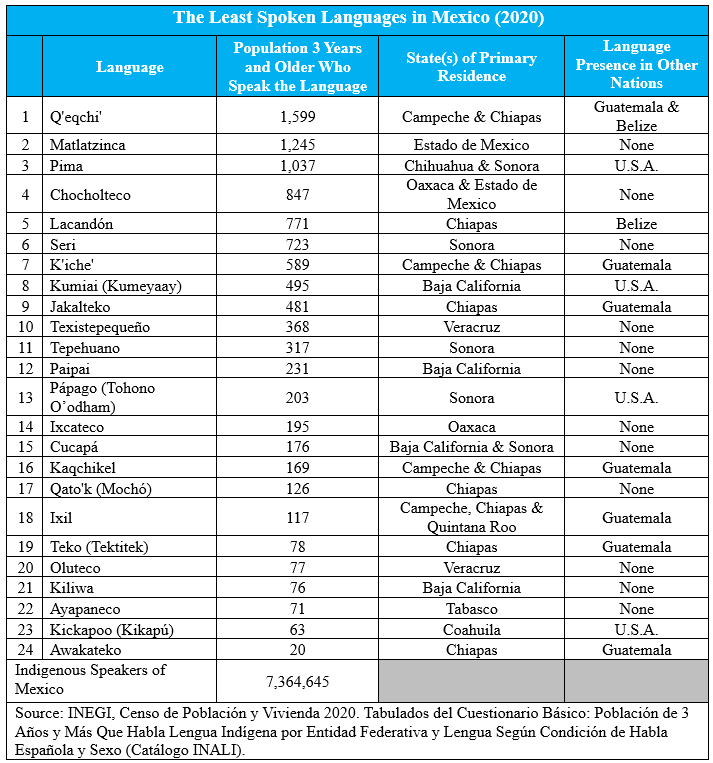
The Least Spoken Languages in Mexico in the 2020 Census
Among the languages listed in the table are many languages (Q'eqchi', K'iche', Jakalteko, Kaqchikel, Ixil, and Teko (Tektitek), and Awakateko) that are also spoken in Guatemala. In fact, many of the people speaking these languages sought refuge in Mexico during the last two centuries or as a result of the Guatemalan Civil War (1960-1996). In addition, the Pima, Pápago (Tohono O’odham), Kumiai (Kumeyaay), and Kickapoo languages also have a traditional presence within the boundaries of the United States. [In fact, the Kumeyaay have 13 separate reservations in San Diego County, California.] It should be noted also that the Baja California languages listed in the table have been on the verge of extinction for more than a century and their precarious status has been a long-standing issue.
Each language has its own challenges, but the main problem is that fewer people from younger generations are speaking these languages. And, as the elders of the language group die out, there are not enough young speakers to replace them… and in some cases, no one to replace them. The Mexican Administration hopes that it can assist in the preservation of these endangered languages.
Recognition of Indigenous Origins
According to the 2020 Mexican census, 19.41% of Mexico’s people identified as Indigenous. However, only 7,364,645 Mexicans (out of a total population of 126,014,024) actually spoke an indigenous language, accounting for 6.1% of Mexico’s population. This fact clearly states that, while some people speak an Indigenous Language, many more people who identify as Indigenous do not actually speak an Indigenous language (about 13.3% of Mexico’s population).
New Challenges Since 2020
In 2023, Karen Tlali wrote an article for Revista Central in which she stated that Mexico was facing the risk of losing 16 indigenous languages. She quoted what Alejandra Frausto wrote in the anthology Linguistic Landscape of Mexico,“If anything defines the peoples of the world, it is their memory, and memory only exists when language appears.” History and memory are paramount when it comes to language, and as Frausto writes, the language of a culture is of primary importance because it is through language that we share knowledge and historical understanding.
Thali wrote that, “In Mexico, every word holds a story. This linguistic diversity is commemorated every February 21st during International Mother Language Day, a date established by UNESCO to highlight the cultural and linguistic diversity that exists in the world.”
However, what happens as the Indigenous languages begin to disappear? According to Thali, “When an Indigenous language disappears, it implies the loss of the memory of an entire culture—in other words, its worldview (all its beliefs, concepts, and the way it sees and explains the world)—and therefore a reduction of Mexico's cultural heritage.”
UNESCO: A Language Disappears Every Two Weeks
According to UNESCO data, a language disappears every two weeks, along with its cultural and intellectual heritage, somewhere in the world. Of the world’s 6,000 languages, 43% are in danger of extinction. This includes Mexico since “many of its languages lack effective methods of transmission and preservation.”
Mexico’s Most Endangered Languages
Today, Mexico’s Indigenous languages with fewer than 100 speakers each are: Kikapú (Kickapoo), Ayapaneco (Tabasco Zoque variant), Kiliwa, Oluteco (Yaak), and Teko (Qyool). Languages with more than 100 but fewer than 200 speakers are: Ixil, Kaqchikel, Cucapá (Cocopah), and Ixcateco.
Zoque-Ayapaneco
Zoque-Ayapaneco is a language of the Mixe-Zoquean family, spoken in the municipio of Ayapa in the State of Tabasco. In 2018, UNESCO reported that only 15 Zoque-Ayapaneco speakers remained. In 2021, it was reported that only two people still spoke the language, and they participated in a workshop to try to save the language and preserve it after their deaths.
Qa'yool Language (Awakateko)
According to an INALI publication in 2024, the Qa'yool language is a binational language belonging to the Mayan language family and is spoken in the Municipio of Champotón in the State of Campeche. A large portion of Qa'yool speakers are also located in Aguacatán, Guatemala. As mentioned earlier, because of the Guatemalan Civil War between 1960 and 1996 and the armed conflict and military repression that accompanied it, various Mayan groups experienced waves of migration to Mexico, settling primarily in the states of Campeche, Chiapas, and Quintana Roo. Qa'yool belongs to the Awakateko-Ixil branch of the Mayan family, making Ixil its closest phylogenetic relative. According to the 2020 Mexican census, Qa'yool had a total of 20 speakers in Mexico. However, based on the Population and Housing Census (INE, 2018), there are 12,541 speakers of the indigenous language in Guatemala.
Ku’ahl
Spoken in Baja California, Ku’ahl (also spelled Ko’alh) is a critically endangered Yuman language spoken by the Kumeyaay people in Baja California, Mexico, specifically within the Paipai community of Santa Catarina. Historically considered a dialect of Tipai, it is now recognized as a distinct language with very few remaining speakers. Ku’ahl belongs to the Cochimí-Yuman language family and is one of the most critical cases in the country. In 2010, no speakers were registered according to the SIC México (Mexico Language Information System), so this language can officially be considered extinct.
Kiliwa
The Kiliwa are another Yuman-Cochimí group found in Baja California. They are different from the Ku’ahl, Paipai and Cucapá — other endangered Indigenous groups from the Baja California region — but the four groups all belong to the Yuman Linguistic Family and all were considered nomadic at one time. They were separated when the borders between Mexico and the United States were established. The SIC Mexico reports a population of only 11 Kiliwa speakers. The Kiliwa live near San Pedro Mártir. In the 2020 Mexican census found 76 Kiliwa speakers in the country.
Matlatzinca
Matlatzinca is one of the few critically endangered Oto-Manguean languages and is mainly spoken by a thousand elders in San Francisco Oxtotilpan (in Toluca Valley of El Estado de Mexico). Closely related to Tlahuica, it is a tonal language. According to UNESCO, there are still 1,548 speakers. The Mexican 2020 census revealed 1,245 speakers of the language. Matzlatzinca is critically endangered because of the marked decline in intergenerational transmission. Urbanization has accelerated this decline, with younger tribal members learning Spanish (for both economic and social reasons) and not learning their ancestral language.
Paipai
Paipai is part of the Cochimí-Yuman family and is primarily spoken in the Santa Catarina municipio of Baja California, about 80 miles southeast of Ensenada. It is also spoken in Arroyo de León and Valle de la Trinidad, rural areas close to Santa Catarina. In the 2020 Mexican census, 231 persons spoke Paipai, but most of them were over the age of 50.
Qato’k (Mochó)
Qato’k, also known as Mochó, is an indigenous Mayan language and group primarily located in the state of Chiapas. In the 2020 census, Qato’k had 126 speakers, including those who speak the Mochó and Tuzanteco variants. Their territory is directly adjacent to the Guatemalan border, and they are considered part of the broader Q’anjob’alan branch of Mayan languages.
The Mochó language has declined so severely that is is considered moribund (on the verge of extinction), with possibly as few as 30 speakers remaining in the present day.
Lengua Xjuani (Ixcateco)
Anyone who has studied the history and languages of Oaxaca sees the state as a Powerhouse among all the states with regards to Indigenous Languages. Linguists find its linguistic diversity to be phenomenal. However, there is among its many languages one endangered tongue. The Ixcatec language, also known as Xjuani, is spoken only in the municipio of Santa María Ixcatlán, an arid area located in the mountains of the Mixteca Alta region in northeastern Oaxaca.
The Ixcatec (or Xjuani) language is a tonal language with three tonal levels, meaning that speakers use pitch to change the meaning of words. Xjuani (Ixcatec) is related to the Énná (Mazatec) language; and both of these languages derive from Popolocan, and, of course, all of these languages belong to the Otomanguean Language Family. Currently, work is underway with the community and municipio authorities to revise and update the Xjuani (Ixcatec) alphabet based on the orthographic proposal developed by Doroteo Jiménez in 1950, a native speaker of the language. New publications in the language are about to be published soon to encourage learning by younger members of the community.
According to the Population and Housing Census (INEGI 2020), there were 195 people in Mexico who speak Xjuani (Ixcatec). This figure reflects the number of people who migrate within the country. The state with the largest number of speakers is Oaxaca, with 140 people, as it is the historical center of this language.
Olutec
Olutec is a critically endangered Mixe-Zoquean language spoken by a few elderly people in the town of Oluta in southern Veracruz. It is a highly specialized, polysynthetic language belonging to the Mixean branch and it is now considered critically endangered or moribund; in other words it is on the verge of extinction as a language. Historically, several factors have influenced its replacement by Spanish, leading to the current situation in which only one proficient speaker (Prisciliano Esteban) and some two-dozen people with some memory of the language remain. Unfortunately, the State of Veracruz has not shown great interest in the preservation of the Olutec language.
Ironically, the State of Veracruz—where 15 Indigenous languages converge with 31 linguistic variants — is one of the most linguistically diverse states in Mexico, with 8.60% of its population speaking an Indigenous language in the 2020 census. In addition, 26.90% of the states’ inhabitants identify as Indigenous. Of its 212 municipios, 47 are considered indigenous, and many more have some Indigenous inhabitants. But, in the 2020 census, only 77 people identified as Oluteco speakers.
Causes of the Disappearance and Death of Indigenous Languages
Among the main factors contributing to the disappearance of languages are the lack of public policies to preserve them, such as their teaching and practice in schools. However, discrimination and exclusion are also significant factors in language loss, especially when indigenous populations face a lack of access to education, resources, or employment. For the younger generation seeking to find their position in Mexican society, speaking Spanish is the answer to their problems.
The predominance of Spanish in education has essentially led to the abandonment of native languages. Furthermore, migration plays a significant role. Given the living conditions in most of these indigenous communities and their marginalized lifestyles, migration to urban areas that offer greater employment opportunities leads to the abandonment of native languages and the adoption of languages like Spanish, which predominate in urban life.
The “18 for 21” Campaign
In commemoration of International Mother Language Day, the “18 for 21” campaign was launched in Mexico. This initiative by Plural TV, the channel of the Supreme Court of Justice of the Nation, was started to raise awareness and strengthen the indigenous languages of Mexico. The project celebrated the country's linguistic diversity with special programming featuring all of the 11 indigenous language families of Mexico. Its objectives include giving visibility to these languages and fostering an understanding of the history and culture of these people.
Mexico’s programs that feature its Indigenous diversity may help to restore pride in the Indigenous languages that have declined so severely over the last century. How successful they will be remains to be seen.
Biblography
Dell’ Amore, Christine, “Sixty Languages at Risk of Extinction in Mexico—Can They Be Kept Alive?” National Geographic, 12 April 2014. Online: https://www.nationalgeographic.com/culture/article/140410-mexico-languages-speaking-cultures-world-zapotec.
Esquivel, Beatriz, “Las Lenguas Indígenas de México Que se Están Muriendo,” Revista Central, February 21, 2023. Online: https://www.revistacentral.com.mx/cultura/lenguas-indigenas-mexico-peligro-desaparicion [Accessed 3/1/2026].
INALI (Instituto Nacional de Lenguas Indígenas), “Lengua Qa’yool (Awakateko).” [Published 24 October 2024]. Online: https://www.inali.gob.mx/detalle/lengua-qayool-awakateko.
INALI, “Lengua Xjuani (Ixcateco),” [Published 9 March 2023]. Online:
https://www.inali.gob.mx/detalle/lengua-xjuani-ixcateco.
INALI, Lenguas Indígenas Nacionales en Riesgo de Desaparición: Variantes Lingüísticas por Grado de Riesgo (2012). Online: https://site.inali.gob.mx/pdf/libro_lenguas_indigenas_nacionales_en_riesgo_de_desaparicion.pdf.
INEGI (Instituto Nacional de Estadística y Geografía), Censo de Población y Vivienda 2020. Tabulados del Cuestionario Básico: Población de 3 Años y Más Que Habla Lengua Indígena por Entidad Federativa y Lengua Según Condición de Habla Española y Sexo (Catálogo INALI).
INPI (Instituto Nacional de los Pueblos Indígenas), “Lenguas indígenas en riesgo de Desaparecer,” (April 1, 2016). Online: https://www.gob.mx/inpi/articulos/lenguas-indigenas-en-riesgo-de-desaparecer.
Noticias de Hoy, “18 por 21”: Llamado a Preservar Las Lenguas Indígenas en México,” [Published Feb. 19, 2026]. Online: https://noticiasdehoy.com.mx/2026/02/18-por-21-llamado-a-preservar-las-lenguas-indigenas-en-mexico/
Ortiz, Modesto, “Olutec: An Indigenous Language in Risk of Extinction” [Published October 15, 2020]. Online:
https://www.entremundos.org/revista/world/olutec-an-indigenous-language-in-risk-of-extinction/?lang=en [Accessed 3 March 2026]
Schmal, John P., “How Many Languages Are Spoken in Mexico?” Online:
https://www.indigenousmexico.org/articles/how-many-languages-are-spoken-in-mexico
Schmal, John P., “Mexico’s Endangered Languages,” Online:
https://www.indigenousmexico.org/articles/mexicos-endangered-languages.
Thali, Karen, “México Enfrenta el Riesgo de Perder 16 Lenguas Indígenas,” Noticias, https://noticias.imer.mx/blog/mexico-enfrenta-el-riesgo-de-perder-16-lenguas-indigenas/ [Accessed 3/1/2026].